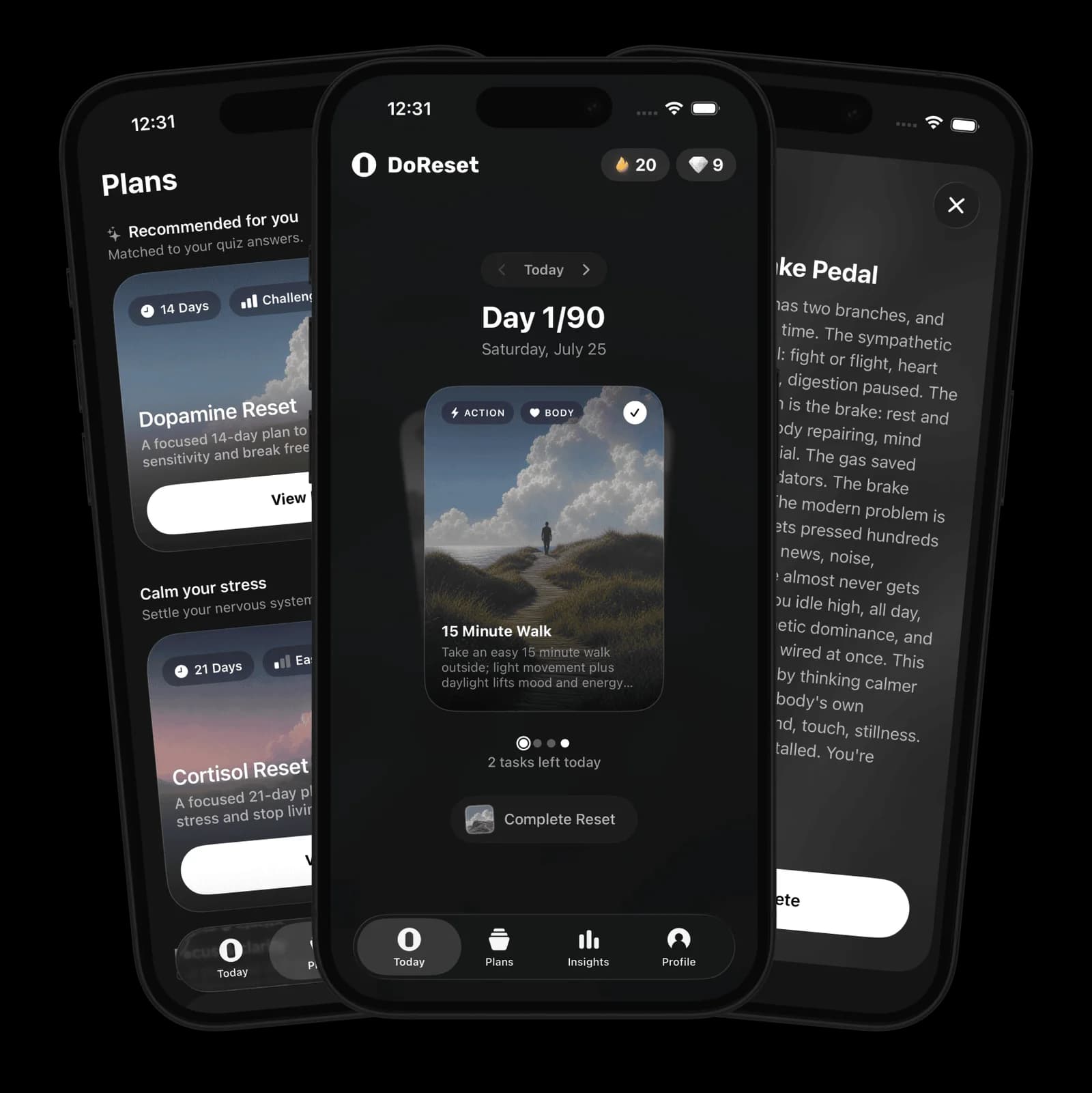
- 21 days
- 15-30 min/day
- Easy
- 3 actions/day
Nervous System Reset: A 21-Day Plan to Calm Your Body's Stress Response
When your body is stuck in high alert, positive thinking does not switch it off. The alarm speaks in breath, temperature, and touch. This 21-day plan teaches you that language, three small actions at a time.

Nervous System Reset
A focused 21-day plan to regulate your body's stress response and feel calm again.
What is the Nervous System Reset?
The Nervous System Reset is a 21-day plan that trains your body's stress response to stand down. It is built around a simple fact: the branch of your nervous system that handles alarm does not respond to reasoning. It responds to physical signals like a long exhale, cold water on your face, vibration from humming, and slow pressure through the soles of your feet.
The plan moves through three phases. Week one builds awareness with body scans, slow breathing, and journaling, so you learn to notice rising tension before it peaks. Week two hands you the regulation toolkit: physiological sighs, extended exhales, humming, shaking, grounding, and deep rest. Week three makes it automatic by pairing the tools with real stressors, so calm becomes something you can produce on demand rather than wait for.
Each day has three short actions and one lesson. Nothing requires equipment, a class, or more than about 30 minutes total. The full day-by-day schedule is below.
Who it's for
- Your shoulders and jaw are tight even on easy days
- Small problems trigger a reaction that feels too big for the situation
- You are exhausted but wired, especially at night
- Relaxing feels vaguely unsafe, like you should be doing something
- Your heart races or your stomach knots without an obvious reason
- You have read about nervous system regulation but never practiced it consistently
The full 21-day schedule
Every day of the plan, exactly as it appears in the app: three actions plus one short lesson.
Week 1Days 1-7
- 10 Minute Body Scan10 min
- 5 Minutes of Slow Breathing5 min
- 15 Minute Walk15 min
Lesson: Gas Pedal, Brake Pedal
- 2 Minutes of Sighing Breaths2 min
- 10 Minute Body Scan10 min
- 30 Minute Wind-Down30 min
Lesson: The Calm Superhighway
- 5 Minutes of Long Exhales5 min
- 10 Minute Stretching10 min
- 15 Minute Walk15 min
Lesson: Calm Lives in the Exhale
- 10 Minute Body Scan10 min
- 10 Minute Journaling10 min
- 20 Minutes in Nature20 min
Lesson: Your Eighth Sense
- 5 Minutes of Long Exhales5 min
- 5 Minute Meditation5 min
- 30 Minute Wind-Down30 min
Lesson: Your Window of Tolerance
- 10 Minute Body Scan10 min
- 10 Minute Stretching10 min
- 5 Minutes of Slow Breathing5 min
Lesson: Listen to Your Body
- 20 Minutes in Nature20 min
- 15 Minute Walk15 min
- 10 Minute Journaling10 min
Lesson: Why Safe Doesn't Feel Safe
Week 2Days 8-14
- 5 Minutes of Humming5 min
- 5 Minutes of Long Exhales5 min
- 30 Minute Wind-Down30 min
Lesson: Three Gears, Not Two
- Cold Water on Your FaceAnytime today
- 2 Minutes of Sighing Breaths2 min
- 5 Minutes of Slow Breathing5 min
Lesson: The Dive Reflex Trick
- 5 Minute Shake It Out5 min
- 10 Minute Stretching10 min
- 15 Minute Walk15 min
Lesson: Shake Like a Gazelle
- 10 Minutes Barefoot Outside10 min
- 20 Minutes in Nature20 min
- 5 Minutes of Long Exhales5 min
Lesson: Be Here Now
- 10 Minute Deep Rest10 min
- 15 Minute Walk15 min
- 30 Minute Wind-Down30 min
Lesson: High-Functioning Numbness
- Take a Cold ShowerAnytime today
- 5 Minutes of Humming5 min
- 5 Minutes of Slow Breathing5 min
Lesson: Cold Exposure Builds Resilience
- 15 Minute Yoga15 min
- 5 Minutes of Long Exhales5 min
- 20 Minutes in Nature20 min
Lesson: Breath Controls State
Week 3Days 15-21
- One Quiet HourAnytime today
- 20 Minute Boredom Walk20 min
- 10 Minute Body Scan10 min
Lesson: Your Senses Need a Diet
- Calm Time TogetherAnytime today
- 15 Minute Walk15 min
- 5 Minutes of Long Exhales5 min
Lesson: Calm Is Contagious
- Write 3 Gratitudes5 min
- 5 Minutes of Humming5 min
- 15 Minute Walk15 min
Lesson: Hunt for Glimmers
- Take a Cold ShowerAnytime today
- 5 Minute Shake It Out5 min
- 10 Minute Meditation10 min
Lesson: Regulation Is a Muscle
- 20 Minute Boredom Walk20 min
- 2 Minutes of Sighing Breaths2 min
- 10 Minute Journaling10 min
Lesson: Walking as Meditation
- Calm Time TogetherAnytime today
- 20 Minutes in Nature20 min
- Write 3 Gratitudes5 min
Lesson: Connection Over Collection
- 10 Minute Body Scan10 min
- 5 Minutes of Long Exhales5 min
- 10 Minute Journaling10 min
Lesson: You Speak the Language Now
Sample actions from the plan
A few of the daily actions you'll complete during the 21 days.

2 Minutes of Sighing Breaths
Do 2 minutes of physiological sighs, double inhale through the nose then long exhale, to calm down fast

10 Minute Body Scan
Move your attention slowly from head to toe for 10 minutes, noticing tension and sensation without fixing anything

5 Minutes of Humming
Hum slowly for 5 minutes, long low notes on the exhale, and let the vibration tone your vagus nerve

10 Minute Deep Rest
Lie down for 10 minutes of non-sleep deep rest, scanning your body and letting everything unclench
The science behind it
Your autonomic nervous system has two main modes: sympathetic (mobilize, fight or flight) and parasympathetic (rest, digest, recover). Neither is bad. Problems start when the sympathetic side stays switched on for weeks, which is increasingly common when stressors are psychological and never physically resolve.
The most direct lever you have is breath. Exhaling slowly activates the vagus nerve, the main highway of the parasympathetic system. Research from Stanford, including a 2023 randomized study led by Melis Yilmaz Balban and Andrew Huberman published in Cell Reports Medicine, found that five minutes a day of exhale-focused breathing, especially the cyclic sighing pattern used in this plan, improved mood and lowered physiological arousal more than mindfulness meditation of the same length.
Other tools in the plan work the same pathway from different angles. Humming stimulates the vagus nerve through vibration in the throat and chest. Cold water on the face triggers the mammalian dive reflex, which slows the heart rate within seconds. Slow walks in nature reliably lower self-reported stress and physiological markers of arousal in controlled studies, and non-sleep deep rest protocols give the system a scheduled window to fully downshift.
None of this requires believing anything. These are reflexes, and the plan simply has you practice triggering them until doing so is second nature. You can read more about the research behind every DoReset plan on our science page.
What to expect
Days 1-7
Learning to feel your state
Body scans and slow breathing feel awkward at first, and noticing your tension can briefly make it louder. By the end of the week you can tell the difference between calm and alert from the inside, which changes everything that follows.
Days 8-14
The toolkit clicks
Physiological sighs start working in real situations, not just on the mat. Sleep tends to deepen this week because the evening practices lower your arousal before bed. Humming and shaking stop feeling silly once you notice the after-effect.
Days 15-21
Regulation on demand
You catch stress early and downshift it in under a minute. The quiet hour and barefoot grounding sessions feel restorative instead of boring. You finish with a personal shortlist of tools that reliably work for your body.
Nervous System Reset FAQ
Common questions about the 21-day plan.
How do you reset your nervous system?
How long does it take to regulate a dysregulated nervous system?
What is a physiological sigh?
Is 15-30 minutes a day really enough?
Why is this plan rated Easy when stress feels so hard?
How is this different from the Cortisol Reset?
Can I do this alongside therapy or medication?
What if I miss a day?
Learn the method
Free guides that pair with this plan.
Not sure the Nervous System Reset is right for you?
Take the free 2-minute quiz. It scores 14 resets against your answers and recommends the plan your life needs first.