How to Do a Dopamine Detox (Rules, Timeline, and a 14-Day Plan)
Somewhere between the tenth and the hundredth time you catch yourself scrolling without deciding to, the question arrives: why does everything else feel so boring? Books you used to love. Work you chose. Dinner with people you like, interrupted by a phone you do not remember picking up.
A dopamine detox is the most popular answer on the internet, and also one of the most misunderstood. Done wrong, it is a weekend of white-knuckled boredom that ends in a three-hour binge. Done right, it is a structured break from engineered stimulation that measurably changes how rewarding ordinary life feels. This guide covers what a dopamine detox actually is, the rules that matter, a realistic timeline of what you will feel, and a step-by-step method drawn from the 14-Day Dopamine Reset, which schedules the whole process for you.
Quick answer
A dopamine detox is a set period where you cut fast, unpredictable rewards like social media, short-form video, gaming, and junk food so your brain's reward system can rebalance. You do not actually lower dopamine; you lower the constant stimulation that has made normal life feel boring. Most people run one for 1 to 14 days and replace the cut habits with slower rewards like walking, reading, and real conversation.
What a dopamine detox actually is
First, the name is misleading. You cannot detox from dopamine and you would not want to: it is a neurotransmitter your brain needs for motivation, movement, and learning. What you can do is reduce the constant, engineered spikes that modern apps deliver, and that is what the practice really targets.
Here is the mechanism. Dopamine rises in anticipation of a reward, and it rises hardest for rewards that are fast and unpredictable. Social feeds, short-form video, and loot-box games are built directly on that principle, called variable reward. Every swipe is a small pull of a slot machine lever. Repeat it a few thousand times a day and your brain adapts to the elevated stimulation. Psychiatrist Anna Lembke, who runs Stanford's addiction medicine clinic and wrote Dopamine Nation, describes the result as a raised baseline: the same activities produce less pull, quiet moments feel uncomfortable, and everything slow starts to feel gray.
A dopamine detox interrupts that cycle. You remove the highest-stimulation inputs for a set period, tolerate the discomfort while your reward system recalibrates, and deliberately practice slower activities so your brain relearns to find them rewarding. The point is not punishment or digital minimalist purity. The point is getting your baseline back.
The dopamine detox rules that actually matter
You will find detox rule lists banning everything from music to eye contact. That version fails because it is unsustainable and it is not what the science supports. Four rules cover what matters.
Rule one: cut the engineered stuff, not everything pleasant. Social media, short-form video, gaming, porn, and ultra-processed snacks are designed for compulsion. Walks, meals with people, books, and exercise are not the problem, and keeping them is what makes the detox survivable.
Rule two: pick a defined period and a clear scope before you start. One day fully offline, or 14 days with targeted limits, both work. Deciding in the moment does not, because in the moment the craving votes.
Rule three: replace, do not just remove. Every removed input leaves a gap in your day, and unfilled gaps get refilled by the old habit. Schedule the replacement explicitly: a walk where the morning scroll was, a book where the evening feed was.
Rule four: expect the discomfort and treat it as data. Restlessness and boredom in the first days are not signs it is failing. They are the signal that your reward system noticed the change and has started adjusting.
How to do a dopamine detox, step by step
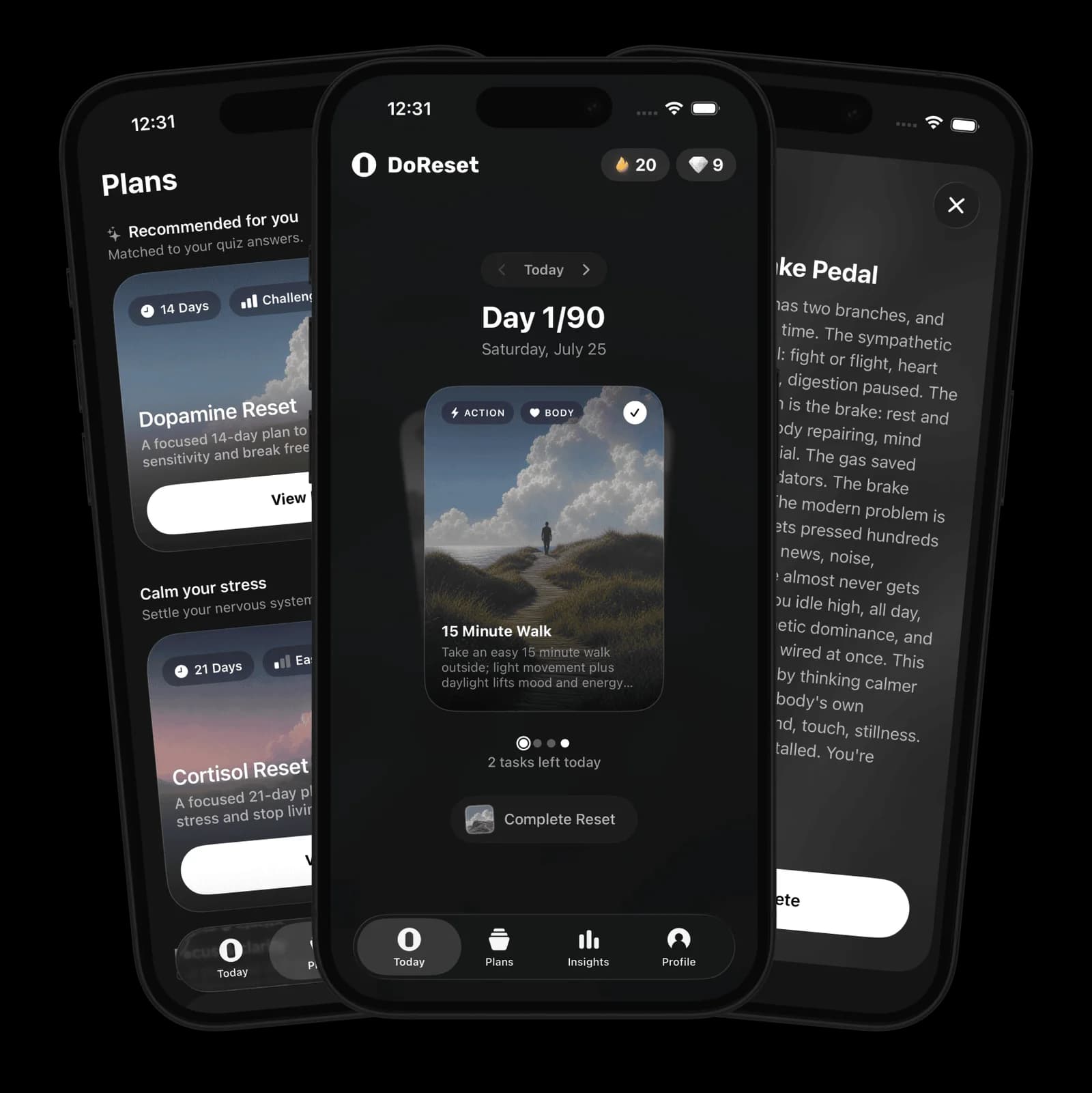
These six steps are the opening arc of the 14-Day Dopamine Reset, ordered from easiest to hardest. Each one is a real action from the plan; together they take you from cutting triggers to comfortably spending hours without stimulation.

Silence your notifications
Mind · Anytime today
Turn off every notification that is not a real person trying to reach you. Badges, likes, news alerts, streak reminders from apps you do not care about: all of it goes. This is the highest-leverage five minutes of the entire detox, because each notification is an external dopamine trigger you never chose.
Do it once, properly, at the settings level. If an app gives you anxiety about turning it off, that is evidence you should.

Make mornings and meals phone-free
Mind · Anytime today
Do not touch your phone for the first hour after waking, and keep it off the table at every meal. The morning scroll sets your dopamine expectation for the whole day, and eating while scrolling is textbook dopamine stacking: neither the food nor the feed registers properly.
Charge the phone outside arm's reach and use a separate alarm. Meals give you three more built-in reps of stillness a day, no scheduling required. The first mornings are hard; by day five most people call that hour the calmest part of their day.

Take full days off social media
Mind · Anytime today
Pick specific days that are completely social-media free, not reduced, free. Partial limits leak, because one quick check reopens the loop you are trying to close.
Log out everywhere and move the apps off your home screen, or delete them for the day. Notice what you reach for when the urge hits; that reflex is the habit loop showing itself, and seeing it clearly is half the work of breaking it.

Walk 20 minutes with nothing in your ears
Body · 20 min
No phone, no podcast, no music. Just you and an unimpressive walk around the block. This is the replacement habit that does the most rebuilding: boredom is the state your brain has learned to escape at all costs, and deliberately staying in it retrains that reflex.
The first walks feel itchy. Then, usually within a week, they become where your best thinking happens. Mind-wandering is strongly linked to the kind of creative problem-solving that never surfaces while you are consuming content.

Give 30 minutes a day to an analog hobby
Spirit · 30 min
Drawing, cooking, an instrument, a puzzle, anything hands-on that produces rather than consumes. Effort-based rewards release dopamine too, but on a slower, steadier schedule that builds motivation instead of hijacking it. This is the replacement half of the detox: the scroll time has to go somewhere.
Pick the hobby before the detox starts and put the materials somewhere visible. The activation energy of deciding what to do in the moment is where most replacement habits die.

Work up to a 2-hour dopamine fast
Mind · 120 min
Two hours with no screens, no snacks, no stimulation. Walk, sit, stretch, journal, stare out the window. This is the detox in concentrated form, and it belongs at the end of your first week, not the start.
It sounds brutal on day one and feels surprisingly spacious by day seven, which is the clearest evidence you will get that your baseline is moving. The full 14-day plan extends this to a half-day fast and one complete no-phone day.
What to expect: the timeline
Days 1-2
Withdrawal-lite
Restlessness, irritability, phantom phone reaches, and a strong pull to negotiate exceptions. Cravings peak on day two for most people. Nothing is wrong; this is the adjustment starting.
Days 3-5
The fog lifts slightly
Urges arrive less often and pass faster. Time feels strangely abundant. Sleep often improves first, especially if evenings went screen-free.
Days 6-9
Slow rewards start registering
Reading holds you longer, conversations land better, and the boredom walk stops feeling like a chore. This is the window where most people report their focus visibly improving.
Days 10-14
New baseline
Quiet feels normal instead of threatening. The question shifts from how do I survive this to which of these habits do I keep. That question is what the last days of a structured plan are for.
Common mistakes to avoid
Going monk mode on day one
Banning music, friends, and flavor makes the detox so miserable you associate the whole idea with suffering. Cut the engineered stimulation; keep the genuinely restorative things.
Removing without replacing
An empty evening does not stay empty. If the scroll time is not deliberately reassigned to walks, hobbies, or people, it flows straight back to the phone.
Treating one hard day as a reset button
A single heroic offline Sunday followed by a normal week changes nothing. Fourteen moderate days beat one extreme one, because adaptation comes from repetition.
Keeping the triggers in reach
Willpower loses to a home screen full of red badges. Change the environment first: notifications off, apps buried or deleted, phone charging in another room.
Quitting at the boredom spike
The discomfort around days two and three is the detox working, not failing. People who know the timeline in advance push through it; people who expected instant calm bail.
Declaring victory and reinstalling everything
The detox ends but the apps have not changed. Without explicit re-entry rules, time limits, no home-screen placement, no morning use, the old baseline rebuilds within weeks.
Frequently asked questions
The long-tail questions, answered directly.
Does a dopamine detox actually work?
How long should a dopamine detox last?
Can I use my phone during a dopamine detox?
What is the difference between a dopamine detox and dopamine fasting?
What are the benefits of a dopamine detox?
Do I have to quit music, exercise, or talking to friends?
What should I do instead of scrolling?
Want this scheduled for you?
The free 2-minute quiz scores 14 reset plans against your answers, including the 14-Day Dopamine Reset, and recommends where to start.