
Rebooting Your Life: A Complete Guide to Starting Fresh

Doreset
March 15, 2026
Life has a way of piling up. Commitments accumulate, habits harden into routines we never consciously chose, and patterns embed themselves so deeply we forget they're not permanent. If you're feeling stuck, exhausted, or simply disconnected from the person you want to be, you're not alone. The good news? You hold the power to hit pause, reassess everything, and rebuild from a place of clarity and intention. Rebooting your life isn't about abandoning who you are; it's about dismantling what no longer serves you and carefully reconstructing the foundation of a more authentic, fulfilling existence.
Understanding What Rebooting Your Life Really Means
When we talk about rebooting your life, we're referring to a deliberate, structured process of transformation. This isn't about superficial changes or quick fixes. It's about examining the core systems that run your daily existence: your habits, beliefs, relationships, and priorities.
Think of it like restarting a computer that's become sluggish and unresponsive. Over time, unnecessary programs run in the background, files accumulate, and the whole system slows down. A proper reboot clears the cache, stops unnecessary processes, and restores optimal function.
Your life operates similarly:
- Mental clutter accumulates from years of conditioning
- Emotional baggage weighs down your decision-making
- Physical habits compound into health issues
- Relationship patterns repeat without examination
- Career paths continue out of inertia rather than intention
The process of rebooting your life requires both courage and compassion. You're essentially acknowledging that your current operating system needs an upgrade, and that takes humility. But it also takes self-love to believe you deserve better.

Recognizing When You Need a Complete Reset
Sometimes the signs are obvious. A major life event like divorce, job loss, or health crisis forces your hand. Other times, the need creeps up quietly through persistent dissatisfaction, numbness, or the nagging sense that you're living someone else's version of your life.
Common Indicators It's Time for Change
You might need to consider rebooting your life if you're experiencing:
- Emotional exhaustion despite adequate rest
- Autopilot living where days blur together
- Relationship strain across multiple connections
- Physical symptoms from chronic stress
- Lost sense of purpose or direction
Many people over 60 find themselves at this crossroads, as resources for late-life transformations demonstrate. But this need transcends age. Whether you're 25 or 65, the desire to realign with your authentic self is valid and worthy of attention.
The challenge lies in distinguishing between normal life fluctuations and genuine misalignment. A helpful framework involves assessing your energy, joy, and growth across key life domains.
| Life Domain | Thriving | Surviving | Struggling |
|---|---|---|---|
| Physical Health | Energized, strong | Getting by | Depleted, sick |
| Relationships | Connected, supportive | Functional | Isolated, toxic |
| Career/Purpose | Fulfilled, growing | Paying bills | Miserable, stuck |
| Mental/Emotional | Clear, resilient | Managing | Overwhelmed, anxious |
If you find yourself primarily in the "surviving" or "struggling" columns, that's your signal. Your system is telling you something needs fundamental revision, not just minor tweaking.
Creating Space for Transformation
Before you can rebuild, you must make room. This demolition phase feels uncomfortable because you're removing familiar structures, even ones that hurt you. But just as a building renovation requires clearing the old framework, rebooting your life demands honest inventory and strategic removal.
The Art of Letting Go
Start by identifying what's actually taking up space in your life:
- Time commitments that drain without replenishing
- Relationships that consistently leave you feeling worse
- Beliefs inherited from family or culture that don't fit your truth
- Possessions that clutter your physical and mental environment
- Digital distractions that fragment your attention
This isn't about becoming a minimalist or cutting everyone out of your life. It's about conscious curation. Each element you keep should either bring you joy, serve a necessary function, or align with your values.
The structured guidance for life reinventions emphasizes the importance of this clearing phase. Without it, you're just adding new habits on top of old dysfunction, creating instability rather than transformation.
Practical clearing exercises include:
- Conducting a time audit for one week
- Writing a "stop doing" list before a "start doing" list
- Having difficult but necessary conversations
- Physically decluttering one space completely
- Unfollowing or muting social media accounts that trigger comparison
Each act of release creates breathing room for what matters. You'll likely feel grief during this process. That's appropriate. You're mourning the loss of familiar patterns, even painful ones. Honor that grief while continuing forward.

Building New Foundations Through Intentional Habits
Once you've created space, the real work of rebooting your life begins: reconstruction. This is where many people stumble because they try to change everything at once, leading to overwhelm and eventual collapse back into old patterns.
Research on habit formation shows that sustainable change happens through small, consistent actions compounded over time. You're not looking for dramatic overnight transformation. You're building a new operating system, and that requires patience and precision.
The 90-Day Reset Framework
Three months provides enough time to establish new neural pathways without the intimidation of "forever" commitments. Within this timeframe, you can systematically address different life areas while maintaining momentum.
Week 1-4: Foundation Setting
- Establish basic routines (sleep, movement, nutrition)
- Create environmental supports
- Build accountability structures
- Define clear metrics for success
Week 5-8: Pattern Interruption
- Identify and disrupt automatic behaviors
- Practice new responses to old triggers
- Experiment with different approaches
- Refine what's working, adjust what isn't
Week 9-12: Integration and Solidification
- Deepen commitment to new habits
- Handle setbacks with self-compassion
- Celebrate progress milestones
- Plan for maintenance beyond the reset period
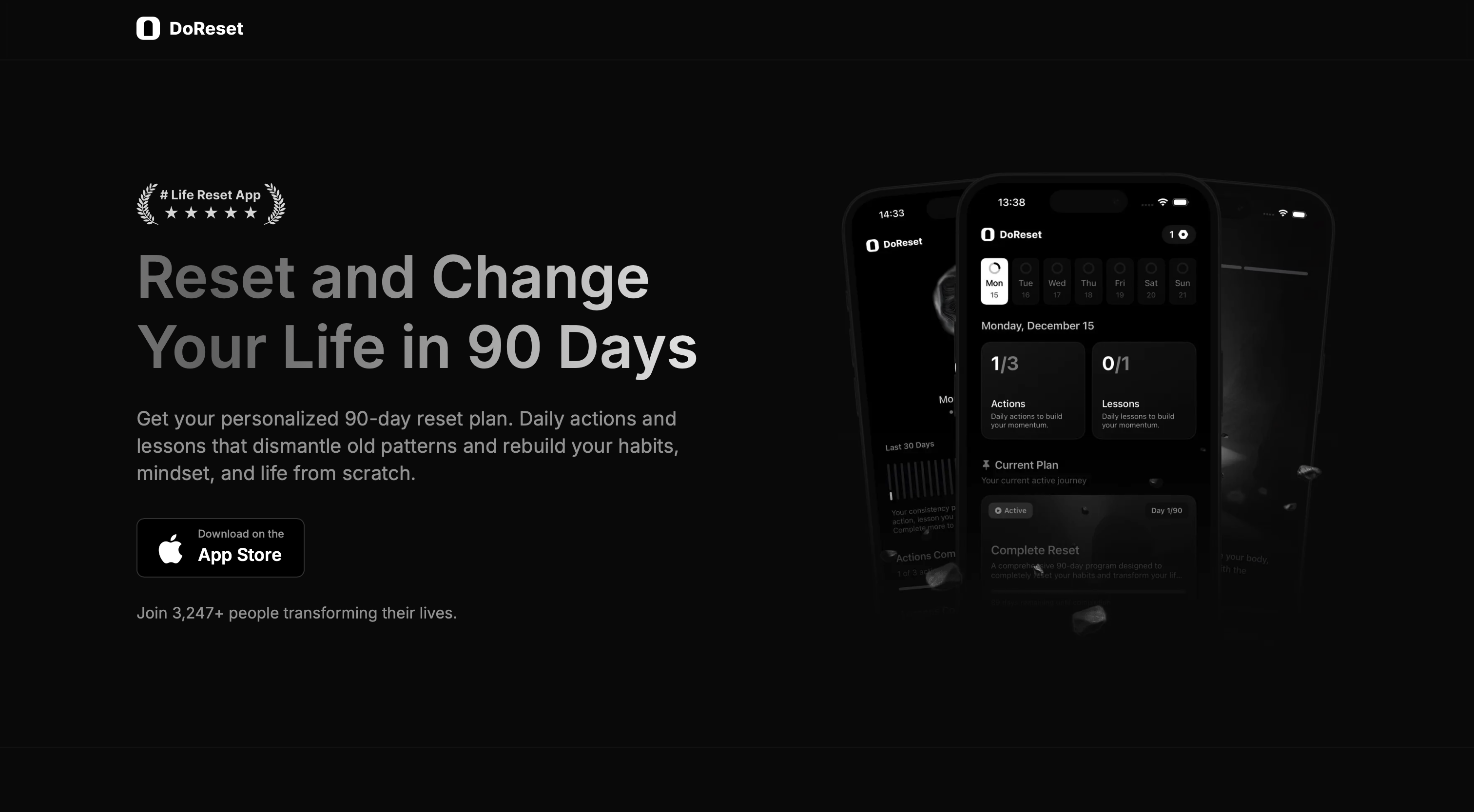
The DoReset mobile app provides this exact structure, offering daily actions and lessons that guide you through dismantling old patterns and rebuilding your habits, mindset, and life from scratch over 90 days. This personalized approach ensures you're not navigating the transformation alone, but with expert guidance tailored to your specific needs.
Developing a Reset Mindset
Physical changes mean little without the internal shifts that sustain them. Rebooting your life requires cultivating a mindset that supports continuous growth, handles setbacks gracefully, and maintains commitment when motivation fades.
This mental framework rests on several core principles that separate temporary changes from lasting transformation. Understanding and practicing these principles becomes as important as the specific actions you take.
Core Mental Shifts for Lasting Change
| Old Mindset | Reset Mindset |
|---|---|
| "I've always been this way" | "I'm capable of evolving" |
| "Change is hard" | "Growth requires discomfort" |
| "I should be further along" | "Progress isn't linear" |
| "I failed, so I'll quit" | "Setbacks provide data" |
| "I need to be perfect" | "Consistency beats perfection" |
Developing a reset mindset means recognizing that your identity isn't fixed. The stories you tell yourself about who you are and what you're capable of are just that-stories. And stories can be rewritten with intention and evidence.
One powerful practice involves reframing your internal dialogue. Instead of "I'm terrible at maintaining routines," try "I'm learning to build systems that support consistency." The shift from fixed identity to active process changes everything.
Daily mindset practices include:
- Morning intention setting (3-5 minutes)
- Evening reflection on progress and lessons
- Weekly review of wins and adjustments needed
- Monthly assessment of alignment with values
- Quarterly celebration of transformation milestones
These practices create the mental infrastructure that supports behavioral change. Without them, you're trying to build a house on sand.
Navigating the Emotional Terrain of Transformation
Rebooting your life isn't just a practical process. It's deeply emotional work that will surface feelings you've possibly avoided for years. This emotional dimension catches many people off guard, leading them to abandon their reset when difficult feelings emerge.
Understanding that emotional turbulence is part of the journey, not a sign you're doing it wrong, helps you persist through the challenging middle phase where old patterns have been disrupted but new ones aren't yet comfortable.
Common Emotional Phases During a Life Reboot
The transformation journey typically follows predictable emotional patterns:
- Initial excitement and relief at taking action
- Uncomfortable awareness of how deep patterns run
- Resistance and self-doubt when change feels hard
- Anger or grief about time lost to old patterns
- Growing confidence as new habits take root
- Expanded identity as you embody your new self
As explored in narratives on personal transformation, these emotional cycles repeat at different scales throughout the process. Each time you tackle a new area of your life, you'll likely cycle through similar feelings.
The key is developing emotional resilience. This doesn't mean suppressing feelings or "staying positive." It means building the capacity to feel difficult emotions without being derailed by them. You learn to observe your fear or frustration without letting it dictate your actions.
Emotional support strategies:
- Finding a community or accountability partner
- Working with a coach or therapist
- Journaling to process feelings
- Movement practices that release stored emotion
- Creative expression as an outlet
Remember that the discomfort you're feeling isn't punishment. It's proof you're doing something your nervous system perceives as different and therefore potentially threatening. Your job is to reassure your system that this change is safe while continuing to move forward.

Practical Systems That Support Your Reboot
Theory and intention only take you so far. Rebooting your life requires practical systems that turn aspirations into daily reality. These systems act as scaffolding during the construction phase, supporting you when willpower wanes and motivation fluctuates.
Building Your Reset Infrastructure
Environmental design plays a massive role in behavioral change. Rather than relying on discipline alone, create surroundings that make desired behaviors easier and undesired ones harder.
Physical environment optimizations:
- Place workout clothes where you'll see them first thing
- Remove junk food from your home entirely
- Create a dedicated space for morning routines
- Use visual cues (post-its, objects) for new habits
- Arrange your digital desktop to support focus
Beyond environment, you need tracking systems that provide feedback without becoming obsessive. The goal is awareness, not perfection. Simple habit trackers, whether digital or paper-based, help you see patterns and celebrate consistency.
For those looking to reboot professional practices, similar principles apply. Whether you're transforming personal life or professional practices, the mechanics of sustainable change remain consistent.
| System Type | Purpose | Example Tools |
|---|---|---|
| Tracking | Monitor progress | Habit tracker, journal |
| Accountability | External motivation | Partner, coach, community |
| Learning | Deepen understanding | Books, podcasts, courses |
| Recovery | Prevent burnout | Rest days, boundaries |
| Celebration | Reinforce progress | Milestone rewards, reflection |
The lifelong lessons you extract from this process become invaluable resources for future challenges. Each time you successfully navigate change, you're building competence that transfers to other life areas.
Sustaining Momentum Beyond the Initial Reset
The most critical phase of rebooting your life comes after the initial transformation period. This is where most people falter, gradually drifting back toward old patterns as the structure of a formal reset ends.
Sustainability requires shifting from intensive transformation mode to maintenance and continuous improvement. You're no longer demolishing and rebuilding; you're refining and optimizing the new systems you've created.
Maintenance Strategies for Long-Term Success
Create a regular review cadence:
- Daily: 5-minute evening reflection
- Weekly: 30-minute assessment and planning
- Monthly: Deep dive into one life area
- Quarterly: Comprehensive life audit
- Annually: Vision recalibration and goal setting
These reviews prevent drift. They create regular checkpoints where you assess alignment between your actions and values, catching small deviations before they become major detours.
Another key strategy involves planned disruption. Ironically, introducing controlled challenges keeps your systems adaptive. This might mean taking on a new skill, traveling alone, or deliberately breaking a routine to ensure you're choosing behaviors rather than just repeating them mindlessly.
Physical health resets, like those outlined in juice cleanse plans or extended health protocols, demonstrate how focused interventions can jump-start broader life changes. Sometimes a dietary reset provides the energy and clarity needed to tackle deeper patterns.
Long-term success indicators:
- You make decisions based on values, not impulse
- Setbacks don't trigger complete abandonment
- You feel genuine connection to your daily life
- Energy levels remain relatively stable
- Relationships deepen rather than stagnate
The goal isn't perfection or permanent arrival at some ideal state. It's cultivating the capacity to notice when you're drifting and having the tools to course-correct quickly. Rebooting your life becomes not a one-time event but a skill you can deploy whenever needed.
Building Community and Accountability
Transformation happens more effectively within community. While the work of rebooting your life is deeply personal, attempting it in isolation makes it unnecessarily difficult. Humans are social creatures; we regulate each other's nervous systems, mirror behaviors, and provide external motivation when internal reserves run low.
Finding or creating the right support structure significantly impacts your success rate. This doesn't mean you need a large group. Often, a single committed accountability partner provides more value than a dozen casual connections.
Types of Support That Accelerate Change
- Accountability partners who check in regularly on specific commitments
- Mentors who've navigated similar transformations
- Communities of others actively working on growth
- Professional support from coaches or therapists
- Family members who understand and respect your process
The key is matching the support type to your specific needs. Some people thrive with daily text check-ins. Others prefer weekly deep conversations. Some need professional guidance to navigate complex emotional terrain.
Be selective about who you share your transformation journey with. Not everyone in your life will understand or support your growth. Some may feel threatened by your changes. Others may unintentionally undermine your efforts through well-meaning but misguided advice.
Green flags in support relationships:
- Celebrates your wins without comparison
- Holds you accountable without judgment
- Offers perspective when you're stuck
- Respects your boundaries and pace
- Challenges you to stretch while supporting you
Red flags to watch for:
- Minimizes your struggles or progress
- Makes your journey about their opinions
- Consistently cancels or shows up unprepared
- Uses your vulnerabilities against you
- Projects their fears onto your goals
Remember that asking for help isn't weakness. It's strategic intelligence. The most successful transformations involve people who recognized their limitations and sought appropriate support rather than white-knuckling through alone.
Rebooting your life is one of the most challenging and rewarding endeavors you'll undertake. It requires courage to examine patterns you've lived with for years, compassion to forgive yourself for past choices, and commitment to build something better. The process isn't linear, and there will be moments when you question whether it's worth the discomfort. But on the other side of that discomfort lies a life that actually feels like yours, one built on intention rather than inertia. If you're ready to begin this transformation journey with structured support, DoReset offers a personalized 90-day plan with daily actions and lessons designed specifically to help you dismantle old patterns and rebuild your habits, mindset, and life from scratch.