
Lifelong Lessons That Transform Your Journey Forward

Doreset
March 9, 2026
Life doesn't hand us a manual when we're born. Instead, we collect wisdom through experience, mistake, and reflection. These insights become the lifelong lessons that shape who we are and who we're becoming. Whether you're navigating a career transition, rebuilding relationships, or simply feeling stuck in patterns that no longer serve you, understanding which lessons truly matter can illuminate the path forward. The beauty of these enduring truths is that they remain relevant regardless of age, circumstance, or background, offering guidance when we need it most.
The Foundation of Personal Transformation
Lifelong lessons aren't just platitudes we collect and forget. They're the bedrock principles that influence our daily choices and long-term trajectories. When we truly internalize these lessons, they become part of our decision-making framework, helping us navigate complexity with greater clarity.
The most powerful lessons often come from our most difficult moments. Failure teaches us resilience. Loss teaches us gratitude. Confusion teaches us to seek clarity. These aren't abstract concepts but lived experiences that reshape our understanding of ourselves and the world around us.
Why Some Lessons Stick While Others Fade
Not every piece of advice we receive becomes a lasting part of our wisdom. The lessons that endure share certain characteristics:
- Emotional resonance: They connect with our personal experience
- Practical application: We can use them immediately in real situations
- Universal truth: They remain relevant across different life contexts
- Personal cost: We often learned them through struggle or sacrifice
The difference between hearing advice and learning a lesson lies in integration. When you've genuinely absorbed a lifelong lesson, it changes your behavior without conscious effort. Research shows that continuous learning and professional development create lasting behavioral change when lessons are applied repeatedly in real-world contexts.

Patterns, Habits, and the Lessons They Teach
Your current habits reflect the lessons you've learned, whether consciously or unconsciously. Every pattern in your life exists because at some point, it served a purpose or seemed like the right choice. Understanding this can transform how you approach change.
The Lesson of Pattern Recognition
One of the most valuable lifelong lessons is learning to identify your own patterns before they derail you. This metacognitive skill allows you to step outside yourself and observe your behaviors objectively.
| Pattern Type | What It Teaches | How to Respond |
|---|---|---|
| Emotional reactivity | Your triggers and vulnerabilities | Create space between stimulus and response |
| Relationship dynamics | What you attract and tolerate | Set boundaries aligned with your values |
| Work habits | Your relationship with productivity | Build systems that support sustainable effort |
| Self-talk | Your core beliefs about yourself | Challenge and reframe limiting narratives |
When you spot a destructive pattern early, you gain the power to interrupt it. This awareness becomes one of those lifelong lessons that compounds over time, making you more skilled at self-regulation with each passing year.
Rebuilding From Scratch
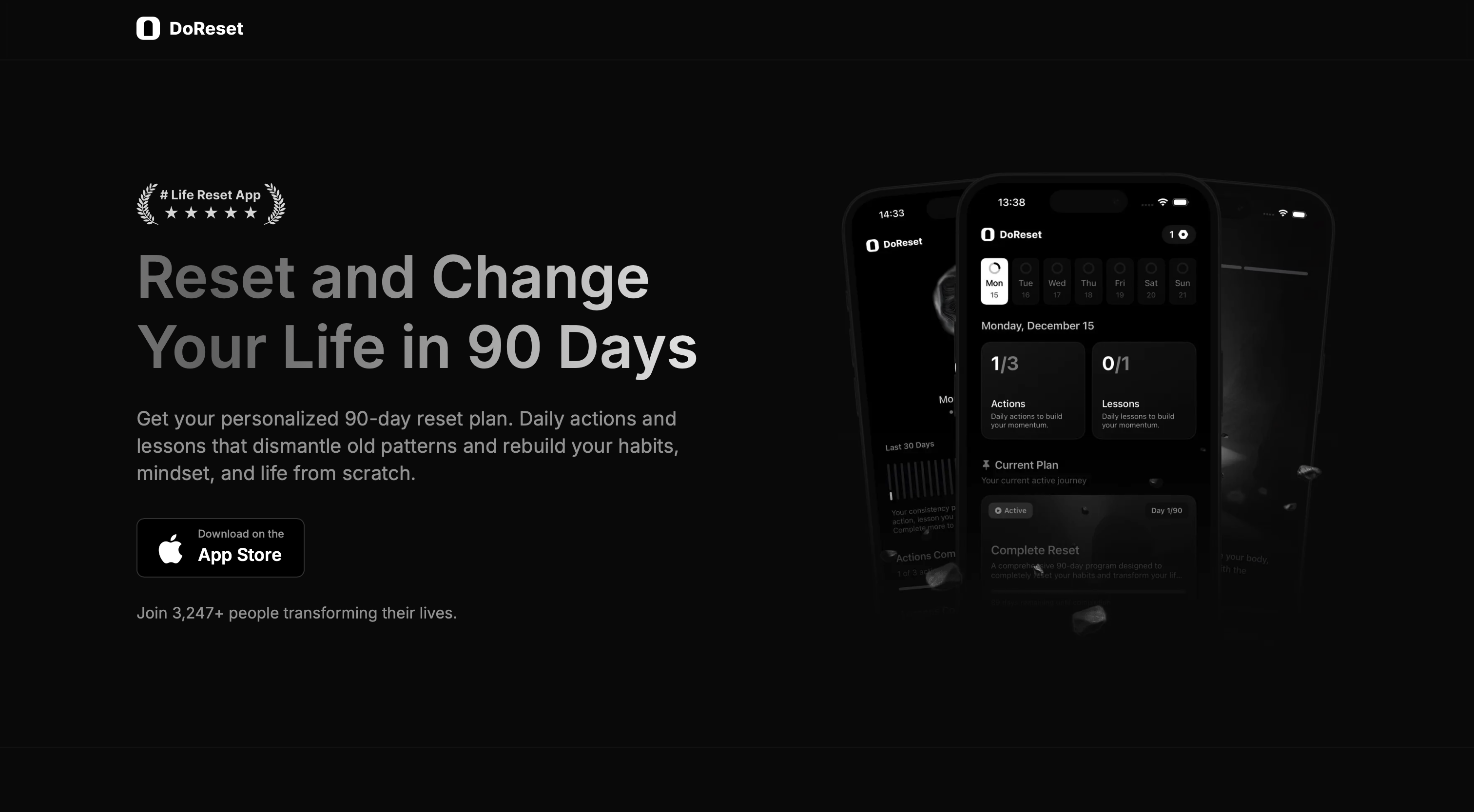
Sometimes the most important lesson is knowing when to tear everything down and start fresh. This doesn't mean abandoning your values or identity, but rather releasing the structures that no longer support your growth. The DoReset mobile app guides individuals through exactly this process, providing a structured 90-day journey to dismantle old patterns and intentionally rebuild habits and mindset from the ground up.
Growth Mindset as a Lifelong Lesson
Perhaps no single concept has transformed modern understanding of personal development more than the growth mindset. This idea, that abilities and intelligence can be developed through effort and learning, represents a fundamental lifelong lesson that changes everything.
When you believe you can grow, you approach challenges differently. Setbacks become data points rather than verdicts. Criticism becomes information rather than attack. The gap between where you are and where you want to be becomes a journey rather than an insurmountable distance.
Developing a growth mindset requires consistent practice. It's not enough to intellectually agree with the concept. You must catch yourself in fixed-mindset moments and consciously redirect your thinking. Over months and years, this practice becomes automatic, transforming your relationship with difficulty and potential.
Practical Applications of Growth Thinking
- Replace "I can't" with "I can't yet": This simple linguistic shift acknowledges current limitations while maintaining future possibility.
- Celebrate effort over outcomes: Focus on what you controlled (your effort, strategy, and persistence) rather than what you didn't (results that depend on many factors).
- Study failure analytically: When something doesn't work, ask "What did I learn?" before asking "Why did this happen to me?"
- Seek challenging situations: Deliberately put yourself in contexts where you're not the most skilled person in the room.
These practices embody the lifelong learning principles that successful people cultivate across their entire lives, creating continuous improvement loops that never end.
The Lesson of Emotional Intelligence
Understanding and managing emotions, both yours and others', ranks among the most valuable lifelong lessons you can develop. Emotional intelligence doesn't mean suppressing feelings or always staying positive. It means recognizing emotional states, understanding their sources, and responding thoughtfully rather than reactively.
Components of Emotional Wisdom
Self-awareness forms the foundation. You can't manage what you don't notice. Building the habit of checking in with yourself throughout the day creates the data you need to understand your emotional patterns.
Self-regulation follows awareness. Once you know you're angry, anxious, or overwhelmed, you can choose how to respond. This doesn't mean never feeling difficult emotions, but rather not letting them make your decisions for you.
- Recognize the physical sensations of emotions in your body
- Name the emotion specifically (not just "bad" but "disappointed" or "embarrassed")
- Identify the trigger or underlying need
- Choose a response aligned with your values
Social awareness and relationship management extend these skills outward. Reading others' emotional states and responding with empathy strengthens every connection in your life.

Time, Energy, and Attention as Finite Resources
Among the hardest lifelong lessons to truly accept is that you cannot do everything. Time is fixed. Energy depletes. Attention fragments. Every yes to one thing is automatically a no to something else.
This scarcity principle applies to:
| Resource | Common Misuse | Lesson to Learn |
|---|---|---|
| Time | Saying yes to obligations that don't align with goals | Ruthless prioritization based on values |
| Energy | Spending emotional energy on unchangeable situations | Focus only on what you can control |
| Attention | Fragmenting focus across too many projects | Deep work on fewer meaningful pursuits |
| Willpower | Using discipline for too many changes simultaneously | Habit stacking and environmental design |
The people who seem to accomplish the most aren't those who try to do everything. They're those who've learned to say no with clarity and conviction, protecting their resources for what truly matters.
The 90-Day Reset Philosophy
Concentrated focus over a defined period creates transformation that scattered effort over years cannot. When you commit to systematic change for 90 days, you harness the power of sustained attention and developing lifelong learning skills through consistent practice.
This approach recognizes that real change requires both intensity and duration. Too short, and new patterns don't take root. Too long, and motivation wanes. Ninety days hits the sweet spot where you can completely reshape a habit, mindset, or area of your life while maintaining momentum.
Relationships Reflect Your Inner Work
The quality of your relationships directly mirrors your relationship with yourself. This lifelong lesson often takes years to fully grasp, but once you do, it transforms how you approach connection with others.
People who haven't learned to set boundaries attract those who don't respect boundaries. People who haven't forgiven themselves struggle to forgive others. People who don't believe they're worthy of love settle for relationships that confirm this belief.
What Your Patterns Reveal
Look at your closest relationships and ask yourself what they're teaching you:
- Do you repeatedly attract people who need saving? You might be avoiding your own needs by focusing on others'.
- Do your relationships feel transactional? You might not believe people would value you for who you are rather than what you provide.
- Do you struggle with intimacy? You might fear being truly seen and potentially rejected.
These patterns aren't permanent verdicts. They're feedback showing you where growth is needed. The insights from lifelong learning apply powerfully to relationship dynamics, as each connection becomes an opportunity to practice new ways of being.
Adversity as Teacher
Perhaps the most universal of all lifelong lessons is that difficulty isn't the enemy of growth but its catalyst. Every person who's achieved something meaningful has a catalog of failures, rejections, and setbacks that paved the way.
The question isn't whether you'll face adversity but how you'll relate to it. Will you see it as evidence that you're not meant for better things, or as the necessary friction that shapes you into someone capable of achieving them?
Reframing Challenges
When faced with difficulty, try asking these questions:
- What is this situation teaching me? Look for the lesson rather than just the problem.
- Who will I become by navigating this? Focus on character development, not just problem resolution.
- What would I tell someone I love in this situation? Often we extend more compassion to others than ourselves.
- What's one small action I can take right now? Forward movement, however slight, builds momentum.
These questions shift you from victim to student, from powerless to empowered. They embody the kind of thinking that turns temporary setbacks into permanent wisdom.
The Compounding Nature of Small Actions
Big transformations rarely happen through single dramatic moments. They happen through small actions repeated consistently over time. This represents one of those lifelong lessons that seems obvious yet most people fail to apply.
The magic isn't in the individual action but in the accumulation. Reading for 15 minutes daily seems insignificant until you realize it's 91 hours of reading in a year. Saving $10 per day seems trivial until it's $3,650 annually plus compound interest.
Why Consistency Beats Intensity
| Approach | Short-term Results | Long-term Results | Sustainability |
|---|---|---|---|
| Intense bursts | High initial progress | Often regresses to baseline | Low - requires constant motivation |
| Consistent small actions | Gradual, barely noticeable | Exponential compounding | High - becomes automatic |
The DoReset approach to personal transformation recognizes this truth, structuring daily actions that compound over 90 days into substantial life changes. It's not about massive overhauls but about showing up each day and taking the next right step.

Self-Compassion Accelerates Growth
Counterintuitively, being hard on yourself doesn't drive change; it prevents it. Self-criticism triggers shame, which activates defensive mechanisms that make learning difficult. Self-compassion, by contrast, creates the psychological safety needed for honest self-assessment and genuine growth.
This lifelong lesson challenges much of what we've been taught about motivation and discipline. We're often told that we need to be tough on ourselves, that accepting our flaws means settling for mediocrity. The opposite is true.
When you treat yourself with kindness, you can afford to look honestly at your mistakes because they don't threaten your fundamental sense of worth. You can acknowledge that you handled a situation poorly without deciding you're a bad person. This distinction is critical.
Practicing Self-Compassion
- Speak to yourself as you would a close friend facing the same situation
- Recognize that imperfection and struggle are part of the shared human experience
- Notice self-critical thoughts without believing or following them
- Celebrate progress while acknowledging room for growth
These practices aren't about lowering standards or avoiding accountability. They're about creating the internal conditions where growth becomes possible rather than paralyzing.
Integration Over Information
We live in an age of infinite information but limited integration. You can access more knowledge in an afternoon than previous generations encountered in lifetimes, yet information without application creates clutter rather than wisdom.
The lifelong lesson here is that knowing isn't enough. You must do. And you must do repeatedly until the knowledge becomes embodied, moving from conscious effort to unconscious competence.
This is why reading self-help books often fails to create change. The insights are valuable, but without a system for integrating them into daily life, they remain theoretical. The gap between knowing what to do and actually doing it represents one of the most significant challenges in personal development.
Building Integration Practices
- Limit inputs: Consume less information more deeply rather than skimming vast quantities
- Immediate application: Use new insights within 24 hours of learning them
- Spaced repetition: Return to important concepts multiple times over weeks
- Teaching others: Explaining ideas to someone else forces clarity and reveals gaps in understanding
- Reflection rituals: Regular journaling or review sessions to process what you're learning
The emphasis on problem-solving and critical thinking in lifelong learning supports this integration approach, helping individuals move beyond passive consumption to active application.
Your Past Doesn't Define Your Future
Perhaps the most liberating lifelong lesson is that you're not trapped by your history. The patterns you've developed, the mistakes you've made, the opportunities you've missed-none of these determine what comes next unless you decide they do.
This doesn't mean ignoring the past or pretending it didn't happen. It means refusing to let it be the only story you tell about yourself. You can acknowledge where you've been while choosing a different direction for where you're going.
Every moment offers a chance to begin again. Not to erase what was, but to create something new. This is the essence of the reset mentality-recognizing that you have the power to dismantle what isn't working and intentionally rebuild something better.
The willingness to start over, to admit that your current approach isn't serving you and commit to trying something different, requires both humility and courage. It's far easier to continue familiar patterns, even destructive ones, than to venture into the uncertainty of change.
The lifelong lessons that truly matter aren't complex or mysterious. They're often simple truths that take years of experience to fully understand and embody. They teach us that growth is always possible, that patterns can be broken, and that who we are today doesn't limit who we can become tomorrow. If you're ready to take these lessons from theory to practice, DoReset provides the structured guidance and daily support to transform your understanding into lasting change, helping you dismantle old patterns and rebuild your life with intention over 90 focused days.