
Rebooting Life: A Guide to Starting Fresh in 2026

Doreset
March 20, 2026
We all reach moments when the life we're living doesn't quite match the life we imagined. Maybe it's a quiet dissatisfaction that builds over months, or perhaps it's a sudden realization that you've been running on autopilot for far too long. Whatever brings you to this point, you're not alone in feeling the need for something different. Rebooting life isn't about admitting failure-it's about honoring your growth and giving yourself permission to start fresh with the wisdom you've gained.
Understanding What Rebooting Life Really Means
Rebooting life goes far deeper than making a few New Year's resolutions or reorganizing your schedule. It's a fundamental recalibration of how you show up in the world, how you spend your energy, and what patterns you allow to shape your days.
Think of it like restarting a computer that's been running too many programs for too long. The system slows down, programs freeze, and nothing works quite right anymore. Your life can feel the same way when old habits, outdated beliefs, and accumulated stress pile up without being addressed.
The Four Dimensions of Personal Reset
Research into mental well-being shows that effective life transformation happens across multiple dimensions:
- Release: Letting go of patterns, relationships, and beliefs that no longer serve you
- Reset: Creating space for new habits and intentional choices
- Reconnect: Building meaningful relationships with yourself and others
- Renew: Discovering fresh purpose and direction in your daily life
Each dimension supports the others. You can't truly reset without first releasing, and renewal becomes possible only after you've reconnected with what matters most to you.

Recognizing When You Need a Life Reboot
Sometimes the signs are obvious-a major life transition, a health scare, or a relationship ending. But often, the need for rebooting life emerges more subtly through persistent feelings and patterns you can't quite shake.
You might notice yourself going through the motions without real engagement. Days blur together, and you struggle to remember what genuinely excited you about your work or relationships. This emotional numbness often signals that your current patterns have stopped serving your growth.
Common Signals That Change Is Needed
| Warning Sign | What It Means | Typical Impact |
|---|---|---|
| Chronic exhaustion despite rest | Energy misalignment with values | Decreased motivation and joy |
| Feeling stuck in repetitive cycles | Outdated habits running the show | Limited personal growth |
| Disconnection from goals | Lost sense of purpose | Difficulty making decisions |
| Emotional numbness | Self-protective shutdown | Reduced life satisfaction |
Physical symptoms often accompany these emotional signals. You might experience disrupted sleep, changes in appetite, or that persistent low-grade anxiety that colors everything you do. Your body knows when your life needs attention, even if your mind hasn't fully acknowledged it yet.
The Psychology Behind Starting Fresh
Understanding why rebooting life works can help you commit to the process with more confidence. Our brains are remarkably adaptable, but they're also creatures of habit. Neural pathways strengthen with repetition, which explains why breaking old patterns feels so challenging at first.
When you deliberately choose new behaviors and thoughts, you're literally rewiring your brain. This neuroplasticity means that change is always possible, regardless of how long you've been stuck in certain patterns. Research on promoting recovery in daily life demonstrates that structured, intentional approaches to change yield measurable improvements in well-being and life satisfaction.
The key is consistency rather than perfection. Small, daily actions accumulate into significant transformation over time. This is why quick fixes and dramatic overhauls rarely stick-they don't give your brain the repetition it needs to establish new pathways.
Building Future Self-Continuity
One fascinating aspect of personal transformation involves strengthening your connection to your future self. Studies show that AI-powered interventions can improve future self-continuity, reducing anxiety and increasing motivation for positive change. When you can vividly imagine and feel connected to the person you're becoming, you're more likely to make choices that serve that future version of yourself.
This connection bridges the gap between knowing what you should do and actually doing it. It transforms abstract goals into tangible commitments because you're not just changing for some theoretical future-you're honoring the person you're actively becoming.
Creating Your Personal Reset Framework
Rebooting life requires more than motivation; it demands a structured approach that supports you through the inevitable challenges. Without a framework, enthusiasm fades when obstacles arise, and you're left with good intentions but little actual progress.
Your framework should address three core elements: awareness of current patterns, action toward new behaviors, and accountability to keep you moving forward even when motivation wanes.
Awareness: Mapping Your Current Reality
Before you can change direction, you need to understand where you actually are, not where you wish you were or think you should be. This honest assessment forms the foundation for meaningful change.
- Track your time for one week without judgment-simply observe how you actually spend your days
- Identify energy patterns-when do you feel most alive versus most depleted?
- Notice automatic responses-what triggers send you into old patterns?
- Examine your environment-what in your physical and social spaces supports or undermines your goals?
- Assess your self-talk-what stories do you tell yourself about who you are and what's possible?
This awareness phase often reveals surprising insights. You might discover that activities you thought energized you actually drain you, or that you're spending hours on things that don't align with your stated priorities.

Action: Designing Daily Practices
Knowledge without action changes nothing. The process of rebuilding your life happens through consistent daily practices that gradually replace old patterns with intentional new ones.
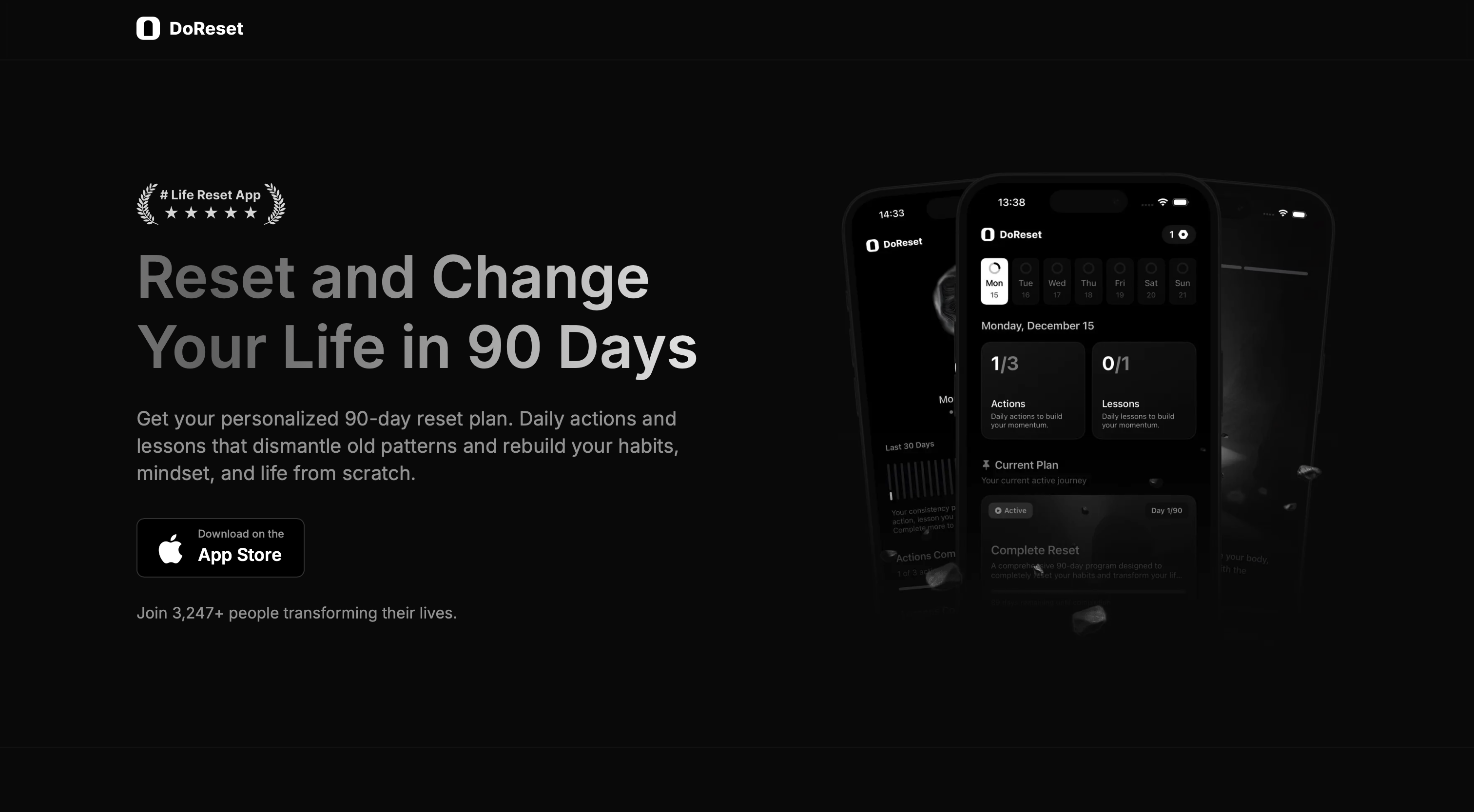
DoReset's approach recognizes that sustainable transformation requires daily guidance and structure. The DoReset mobile app provides a personalized 90-day reset plan that breaks down the overwhelming process of rebooting life into manageable daily actions. Each day brings specific lessons and practices designed to dismantle old patterns while building new habits that align with who you're becoming.
Start with micro-commitments that feel almost too easy to fail at. Want to establish a meditation practice? Begin with two minutes. Looking to change your mindset? Start with one intentional thought replacement per day. These small wins build confidence and momentum that carry you through more challenging changes.
Accountability: Maintaining Momentum
The gap between intention and action often widens when no one's watching. Accountability structures bridge this gap by creating external support for your internal commitment.
- Schedule regular check-ins with yourself to review progress and adjust your approach
- Share your journey with trusted friends who understand your goals
- Track measurable indicators that show you're moving in the right direction
- Celebrate small wins to reinforce new neural pathways
- Plan for obstacles before they derail your momentum
Remember that setbacks aren't failures-they're information. When you slip back into old patterns, approach yourself with curiosity rather than judgment. What triggered the slip? What need were you trying to meet? How can you meet that need in a way that aligns with your new direction?
Navigating the Emotional Journey
Rebooting life isn't a purely logical process. Emotions will rise and fall as you dismantle familiar patterns and step into uncertainty. Understanding this emotional landscape helps you move through it with more grace.
The beginning often brings excitement and hope. You're energized by possibility and the relief of finally taking action. This honeymoon phase carries you forward for days or even weeks.
Then resistance arrives. Old patterns feel comfortable even when they're harmful, and your brain will find countless reasons why change is unnecessary, impossible, or too risky. This is where many reboot attempts fail-not because the person lacks willpower, but because they didn't expect this resistance and interpret it as a sign they're on the wrong path.
Working Through Identity Shifts
One of the most challenging aspects of rebooting life involves shifting your sense of identity. You're not just changing what you do-you're changing who you are. This identity work can feel destabilizing as you release old self-definitions and experiment with new ways of being.
You might feel like an imposter at first when you try on new behaviors. That successful, healthy, purposeful person you're becoming doesn't quite feel like "you" yet. This discomfort is normal and necessary. Research on AI-augmented journaling shows that drawing from past memories while imagining positive futures helps integrate identity shifts and supports mental health during transformation.
Give yourself permission to feel awkward in your growth. Every expert was once a beginner, and every transformed person once felt uncertain in their new skin.
Building Sustainable Systems
The difference between temporary change and lasting transformation lies in the systems you build. Willpower is a finite resource, but systems run on autopilot once established.
Environmental Design
Your environment shapes your behavior more powerfully than your intentions. If you want to read more but keep your phone on your nightstand, you're fighting an uphill battle. Practical steps for rebooting your life include designing your environment to make desired behaviors easier and undesired behaviors harder.
Consider these environmental adjustments:
| Area | Old Pattern | Environmental Redesign |
|---|---|---|
| Morning routine | Checking phone first thing | Move phone to different room; place journal beside bed |
| Eating habits | Snacking on processed foods | Remove junk food; prep healthy snacks in visible containers |
| Work focus | Constant distraction | Create dedicated workspace; use website blockers during deep work |
| Exercise | Skipping workouts | Lay out workout clothes night before; schedule movement like meetings |
Small environmental changes create big behavioral shifts because they work with your brain's preference for convenience rather than against it.
Social Architecture
The people around you either support or undermine your transformation. This doesn't mean everyone who knew the old you will sabotage the new you, but some relationships may need to evolve or fade as you do.
Understanding how to reset your life includes reassessing your social circles and actively cultivating relationships that align with your emerging values. Seek out people who are also committed to growth, who challenge you lovingly, and who celebrate your progress rather than questioning your changes.
You might also need to set new boundaries with people who expect you to stay the same. This can feel uncomfortable, especially with family or long-term friends, but protecting your growth is an act of self-respect, not selfishness.
Measuring Progress Beyond Outcomes
When rebooting life, it's tempting to focus solely on external outcomes-the weight lost, the promotion earned, the relationship status changed. But transformation happens internally first, and measuring only outcomes misses the real progress.
Track process metrics that indicate you're building new patterns:
- Days you completed your morning practice, regardless of how you felt
- Times you chose a supportive response over an automatic reaction
- Moments you recognized and redirected unhelpful thought patterns
- Instances when you honored a boundary even though it felt uncomfortable
- Occasions when you asked for help instead of struggling alone
These process wins matter more than outcome wins because they represent the fundamental shifts that make lasting change possible. The external results will follow when the internal foundation is solid.

The 90-Day Transformation Window
Why 90 days? Research on habit formation shows that significant behavioral change requires consistent practice over an extended period. While the popular "21 days to form a habit" myth persists, most meaningful habits actually take longer to solidify.
A 90-day reset plan provides enough time to move through the excitement phase, work through resistance, and begin experiencing the rewards of your new patterns. It's long enough to create real change but short enough to maintain focus without feeling overwhelming.
During these 90 days, you'll likely experience several cycles of progress and plateau. Understanding this rhythm helps you persist through the plateaus rather than interpreting them as failure. Growth isn't linear-it's cyclical, with periods of rapid advancement followed by integration periods where change consolidates before the next leap forward.
Integrating Digital Wellness
In 2026, rebooting life necessarily includes examining our relationship with technology. Studies on smartphone behaviors and mental health reveal that our digital habits significantly impact our well-being and our capacity for transformation.
Technology can support or sabotage your reset depending on how intentionally you use it. Social media algorithms designed to maximize engagement often pull you away from your intentions. Notifications fragment your attention and prevent the sustained focus necessary for deep change.
Yet technology also offers powerful tools for transformation when used consciously. Apps that guide daily practices, track progress, and provide structure can be invaluable allies in your journey. The key is using technology as a tool that serves your goals rather than allowing it to dictate your attention and behavior.
The Role of Self-Compassion
Perhaps the most crucial element in successfully rebooting life is the relationship you maintain with yourself throughout the process. Change is hard, and you will stumble. How you treat yourself in those moments of stumbling determines whether you get back up or give up entirely.
Self-compassion isn't self-indulgence or making excuses. It's treating yourself with the same kindness you'd offer a good friend who's struggling. It's acknowledging difficulty without dramatizing it, and recognizing your shared humanity in the experience of imperfection.
When you approach lifelong lessons with self-compassion, you create the psychological safety necessary for genuine growth. You can look honestly at your patterns without shame, experiment with new behaviors without fear of judgment, and persist through challenges without harsh self-criticism eroding your motivation.
Research consistently shows that self-compassionate people are more likely to maintain positive changes because they don't abandon their goals after inevitable setbacks. They understand that struggle is part of growth, not evidence of inadequacy.
Moving Forward With Intention
Rebooting life is ultimately about reclaiming authorship of your own story. It's recognizing that while you can't control everything that happens to you, you can choose how you respond and what patterns you cultivate. This empowerment comes not from perfection but from the daily practice of choosing alignment over autopilot.
The journey won't always feel comfortable. Growth rarely does. But discomfort in service of your values and vision feels entirely different from the dull ache of living disconnected from yourself. One expands you; the other diminishes you.
As you move forward, remember that transformation isn't about becoming someone completely different-it's about becoming more fully yourself. You're not adding something foreign; you're releasing what's been covering your authentic self and allowing what's already within you to emerge.
Rebooting life is one of the most courageous acts of self-respect you can undertake, and you don't have to navigate it alone. The journey from awareness to action to lasting change becomes clearer with structured support that meets you where you are each day. DoReset offers a personalized 90-day reset plan that provides daily actions and lessons specifically designed to help you dismantle old patterns and rebuild your habits, mindset, and life with intention and compassion. Your transformation begins with a single decision to start-make that decision today.