
Change Habits: Transform Your Life in 90 Days

Doreset
March 23, 2026
Change isn't just about wanting things to be different. It's about understanding why we do what we do, and having the courage to dismantle the patterns that keep us stuck. If you've ever felt trapped in cycles you can't seem to break, you're not alone. The habits we carry aren't just random behaviors. They're deeply wired responses that once served a purpose, even if they no longer fit the life we want to live. The good news? You have more power than you think to change habits and rebuild your daily existence from the ground up.
Understanding Why We Struggle to Change Habits
Our brains are designed to conserve energy. Every habit you've ever formed, whether helpful or harmful, exists because your mind found a shortcut. This efficiency is beautiful when it helps you brush your teeth without thinking, but it becomes a prison when the automatic response is reaching for your phone instead of connecting with loved ones, or numbing discomfort instead of processing it.
The difficulty isn't your lack of willpower. Research from Duke University highlights how environmental factors play a more crucial role than sheer determination. When you're surrounded by the same triggers, cues, and contexts that reinforced old behaviors, your brain defaults to what it knows. This is why you can feel motivated in the morning but find yourself repeating the same patterns by evening.
The Emotional Weight of Our Patterns
Behind every habit lies an emotion you're either seeking or avoiding. When you understand this truth, you stop judging yourself for struggling. You start seeing your behaviors as adaptations, as coping mechanisms that made sense at some point in your journey.
- Comfort-seeking habits help us escape discomfort, anxiety, or uncertainty
- Validation-seeking patterns fill gaps in self-worth or connection
- Control behaviors give us a sense of safety when life feels chaotic
- Avoidance mechanisms protect us from facing difficult truths or feelings
Acknowledging these emotional underpinnings isn't about making excuses. It's about approaching yourself with compassion as you begin the work of transformation.

The Science Behind Lasting Habit Transformation
When you set out to change habits, you're not just adjusting surface behaviors. You're rewiring neural pathways that may have been reinforced for years or even decades. The National Institute of Diabetes and Digestive and Kidney Diseases outlines stages of habit change that acknowledge this complexity: precontemplation, contemplation, preparation, action, and maintenance.
Most people jump straight to action without honoring the earlier stages. They wake up one day and decide everything will be different, only to find themselves back in old patterns within weeks. Real transformation requires you to move through each phase deliberately.
Building Awareness Before Action
The preparation phase is where real power lives. This is when you observe your current patterns without judgment, noticing the triggers that activate certain behaviors. You might discover that you scroll social media not because you're bored, but because you're avoiding a difficult conversation. You might realize you skip morning routines when you're anxious about the day ahead.
| Stage | What It Involves | Common Challenge |
|---|---|---|
| Precontemplation | Not yet recognizing the need for change | Denial or defensiveness |
| Contemplation | Acknowledging the problem, weighing options | Analysis paralysis |
| Preparation | Creating specific plans and systems | Perfectionism delaying start |
| Action | Implementing new behaviors | Relying solely on motivation |
| Maintenance | Sustaining changes long-term | Boredom or complacency |
When you honor each stage, you build a foundation that supports lasting change rather than temporary bursts of improvement.
Creating Your Personal Reset Framework
To genuinely change habits, you need more than tips and tricks. You need a comprehensive framework that addresses your mindset, environment, and daily actions simultaneously. This is where a structured approach over an extended period, like 90 days, becomes transformative.
Ninety days isn't arbitrary. It's long enough to move through multiple cycles of learning, applying, struggling, adapting, and integrating. It's short enough to maintain focus, yet substantial enough to see genuine transformation. When you commit to a life reset of this duration, you're giving yourself permission to experiment, fail, learn, and try again.
Designing Your Daily Actions
The magic happens in the mundane. Grand declarations feel powerful, but they rarely lead to sustainable change. Instead, focus on identifying small, specific actions you can take consistently. These daily practices become the building blocks of your new identity.
- Choose one keystone habit that will create a ripple effect in other areas
- Attach it to an existing routine to leverage current neural pathways
- Make it incredibly small to reduce resistance (two minutes or less)
- Track completion to build momentum and self-trust
- Reflect weekly on what's working and what needs adjustment
Each action teaches you something about yourself. Each day you show up, even imperfectly, you're gathering evidence that you're someone who keeps commitments to themselves.

Dismantling the Patterns That Keep You Stuck
Before you can fully rebuild, you need to understand what you're dismantling. Your old patterns aren't random. They're interconnected systems that support and reinforce each other. When you try to change habits in isolation, you often miss how they're connected to your broader life structure.
NIH News in Health emphasizes the importance of environment and support systems in this process. Your physical space, social connections, and daily rhythm all play crucial roles. If you want to read more but your phone is always within arm's reach while books are stored away, your environment is voting against your intention.
Identifying Your Habit Loops
Every habit follows a loop: cue, routine, reward. To change habits effectively, you need to map these loops for your specific patterns. The cue might be a time of day, an emotional state, a location, or the presence of certain people. The routine is the behavior itself. The reward is what you gain, even if that gain is temporarily numbing discomfort.
- Morning scrolling loop: Cue (alarm), Routine (checking phone), Reward (distraction from morning anxiety)
- Emotional eating loop: Cue (stress), Routine (snacking), Reward (temporary comfort)
- Procrastination loop: Cue (difficult task), Routine (busywork), Reward (avoiding discomfort)
- Negativity loop: Cue (uncertainty), Routine (catastrophizing), Reward (feeling prepared for worst-case)
When you understand your loops, you can keep the cue and reward while changing the routine. This is more effective than trying to eliminate the entire pattern through willpower alone.
Rebuilding From a Foundation of Self-Compassion
The harshest judge of your habit change journey is often yourself. Every slip feels like failure. Every day you don't show up perfectly becomes evidence that you're not capable of transformation. This internal criticism doesn't motivate sustainable change. It creates shame, and shame drives us back to the very behaviors we're trying to shift.
Gretchen Rubin's work on personality tendencies shows how different people respond to different change strategies. Some need external accountability, others need deep personal conviction. Some thrive with detailed systems, others need flexibility. Understanding your tendency helps you design an approach that works with your nature, not against it.
When you approach the work of changing your mindset with curiosity instead of criticism, you create space for genuine learning. You start noticing patterns without immediately labeling them as good or bad. You become interested in why you made certain choices rather than berating yourself for making them.
The Role of Support in Sustainable Change
No one transforms in isolation. The people around you, the resources you access, and the guidance you receive all influence your capacity to change habits long-term. This doesn't mean you need to announce your intentions to everyone or seek constant external validation. It means being intentional about the influences you allow into your life during this vulnerable period.
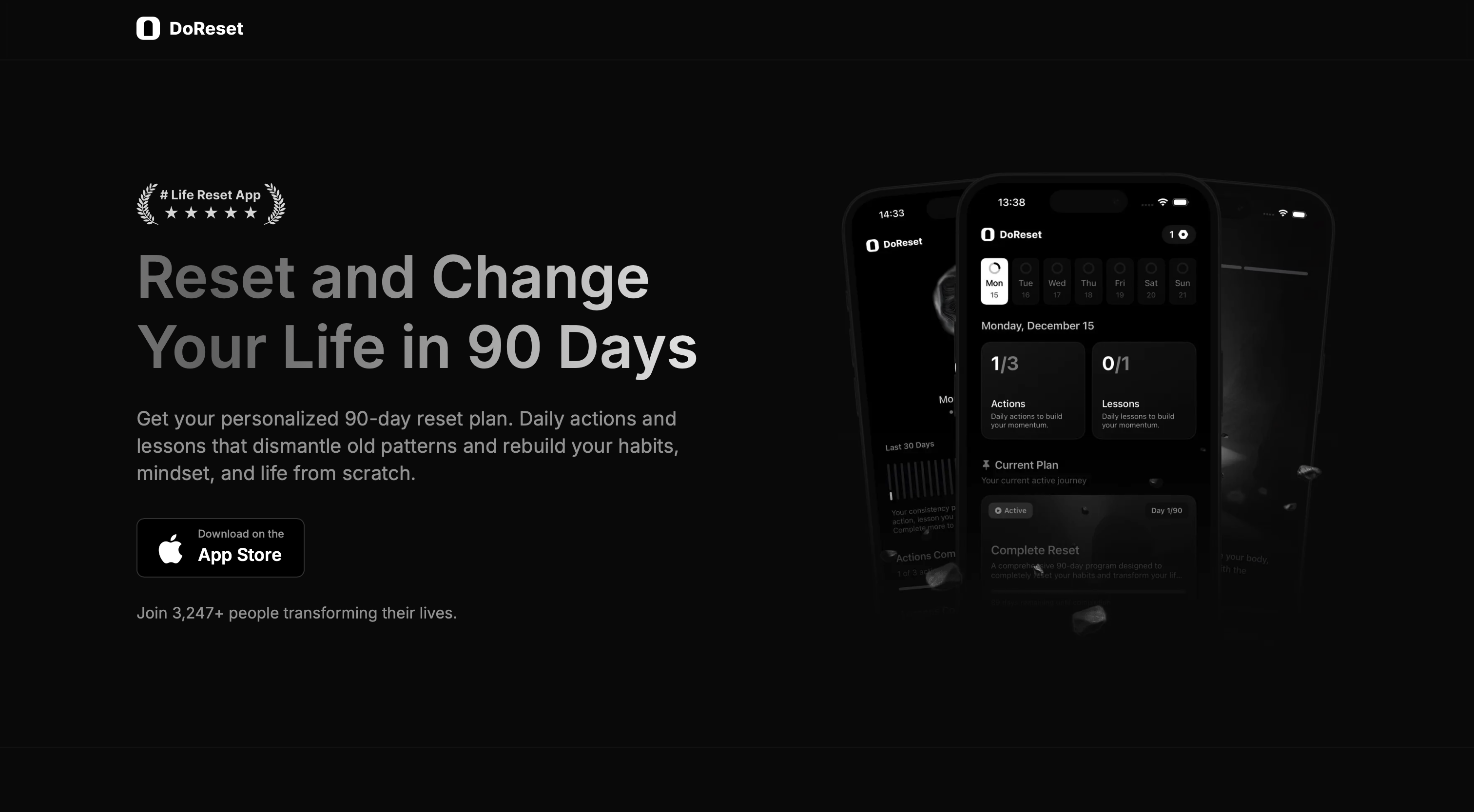
The DoReset mobile app provides personalized daily actions and lessons designed specifically to guide this transformation journey, offering structure without rigidity and support without judgment.
Environmental Design for Habit Success
Your environment is constantly shaping your behavior, whether you're aware of it or not. To change habits effectively, you need to become an architect of your surroundings. This goes beyond keeping cookies out of the house. It's about designing every aspect of your space to support the person you're becoming.
Controlling your environment reduces the need for decision-making and willpower. When your workout clothes are laid out the night before, you've removed one barrier. When your phone charges in another room, you've eliminated the midnight scrolling temptation. When you prepare healthy meals in advance, you're not making food choices when you're hungry and depleted.
Physical and Digital Space Optimization
- Remove friction from desired behaviors: Make good choices the easiest choices
- Add friction to unwanted behaviors: Create steps between you and old patterns
- Use visual cues: Place reminders where you'll see them during vulnerable moments
- Create dedicated spaces: Designate areas for specific activities to build associations
- Batch similar tasks: Group related activities to maintain mental context
| Area | Old Setup | Redesigned for Change |
|---|---|---|
| Morning | Phone on nightstand | Phone charging in bathroom, journal on nightstand |
| Kitchen | Snacks at eye level | Fruit visible, processed food in opaque containers |
| Workspace | Open browser tabs | Single-tasking apps, website blockers enabled |
| Evening | TV default activity | Reading nook with lighting, TV remote stored away |
Small environmental changes compound over time, making the behaviors you want to change habits feel natural rather than forced.

Navigating Setbacks Without Losing Momentum
You will have days when you don't follow through. You'll face moments when old patterns resurface with surprising intensity. These aren't failures. They're data points, opportunities to understand yourself more deeply and refine your approach. The difference between people who successfully change habits and those who don't isn't perfection. It's how they respond to imperfection.
When you miss a day, the critical moment is the next one. Do you spiral into shame and abandon the whole effort, or do you acknowledge what happened with curiosity and return to your commitment? MIT Sloan Management Review research shows that leveraging multiple sources of influence increases success rates significantly. This means having backup plans, alternative strategies, and varied approaches rather than putting all your faith in a single method.
Building Resilience Through Practice
Resilience isn't something you either have or don't have. It's a skill you develop through repeated practice of returning to your values after getting knocked off course. Each time you recommit after a setback, you're strengthening your capacity to handle future challenges.
- Acknowledge the slip without drama: "I didn't follow through today"
- Identify what triggered the old pattern: Context, emotion, circumstance
- Extract the lesson: What does this teach you about your needs or vulnerabilities?
- Adjust if needed: Does your plan need modification, or do you simply need to keep going?
- Return immediately: The next meal, the next hour, the next day-not Monday, not next month
This process of rebuilding your life isn't linear. It's cyclical, with each cycle building on what you learned in previous ones.
Integrating New Patterns Into Your Identity
The ultimate goal isn't just to change habits temporarily. It's to become someone for whom these new behaviors are natural expressions of who you are. This identity-level transformation happens gradually, through consistent action and conscious integration of lessons learned along the way.
When you shift from "I'm trying to exercise" to "I'm someone who moves my body," the behavior stems from identity rather than effort. When you move from "I should read more" to "I'm a reader," picking up a book becomes an expression of self rather than a should. This is how you create lasting changes that don't require constant willpower.
Celebrating Evidence of Transformation
Your brain needs proof that change is happening. Small celebrations reinforce new neural pathways and build positive associations with your new behaviors. This doesn't mean throwing a party every time you complete a task. It means pausing to acknowledge your growth, even in small moments.
Notice when you catch yourself choosing differently. Recognize when an old trigger appears and you respond in a new way. Appreciate the days when what used to require enormous effort now feels almost automatic. These moments of awareness compound into genuine transformation.
The 90-Day Journey of Complete Transformation
Three months is enough time to move through multiple iterations of trying, learning, adjusting, and integrating. It's long enough to encounter obstacles, work through resistance, and build genuine momentum. When you commit to a 90-day reset, you're giving yourself space to experiment with different approaches and discover what actually works for your unique situation.
The first 30 days are often about awareness and establishing basic consistency. You're learning your patterns, identifying triggers, and building the foundational practice of showing up daily. The second 30 days typically involve refinement. You're adjusting your approach based on what you've learned, addressing obstacles, and deepening your commitment. The final 30 days focus on integration, where new behaviors start feeling more natural and you begin seeing compound effects across multiple life areas.
This timeline acknowledges that real change isn't instant, but it also proves that you don't need years to see meaningful transformation. You need intentional, supported, consistent action over a focused period.
Change habits that no longer serve you isn't about becoming a different person. It's about removing the layers of automatic responses that hide who you truly are and what you're capable of. When you approach this work with compassion, structure, and daily commitment, transformation becomes not just possible but inevitable. DoReset offers a personalized 90-day plan that provides the daily actions, lessons, and support you need to dismantle old patterns and rebuild your life from a foundation that truly serves you. Your transformation starts with a single decision to begin, and continues with each small action you take from that moment forward.