
Changing for Life: Your Guide to Lasting Transformation

Doreset
March 16, 2026
When you look at your reflection in the mirror, do you see the person you want to become, or are you still staring at someone trapped in old patterns? The desire for transformation isn't about temporary fixes or fleeting motivation. It's about changing for life in ways that fundamentally reshape who you are and how you move through the world. This journey requires more than wishful thinking. It demands intentional action, compassionate self-awareness, and a willingness to rebuild yourself from the ground up.
Understanding What Changing for Life Really Means
True transformation isn't a destination you reach after reading a self-help book or attending a weekend workshop. It's a continuous process of growth that extends across your entire existence. The Life-span model of motivation helps us understand how our personal goals and developmental trajectories shift as we navigate different social environments and life stages.
Changing for life means:
- Committing to sustainable practices rather than quick fixes
- Building habits that compound over time
- Developing self-awareness that deepens with each passing year
- Creating systems that support your evolution, not just your temporary goals
The difference between people who transform permanently and those who cycle through the same patterns lies in their approach. Temporary changes rely on willpower and motivation, which inevitably fade. Lasting transformation requires restructuring your environment, identity, and daily rhythms so that growth becomes your default setting.

The Foundation of Sustainable Change
You've probably started and stopped more times than you can count. Each January brings new resolutions. Each Monday promises a fresh start. Yet by February, by Wednesday, you're back where you began. This isn't a character flaw. It's the natural result of trying to change without addressing the underlying architecture of your life.
Personal development encompasses multiple dimensions including skill enhancement, goal setting, and holistic well-being. When you attempt to change just one area while leaving others untouched, you create internal conflict that sabotages your progress.
Consider this framework for building change that lasts:
| Element | Temporary Approach | Changing for Life Approach |
|---|---|---|
| Motivation | External pressure | Internal alignment |
| Timeline | 21-30 days | 90+ days minimum |
| Focus | Outcome only | Process and identity |
| Support | Solo willpower | Structured guidance |
| Measurement | All or nothing | Progress over perfection |
Your transformation journey becomes sustainable when you shift from fighting against yourself to creating conditions where growth feels natural. This requires patience with your process and compassion for your setbacks.
The 90-Day Window: Why Time Matters
Research consistently shows that meaningful habit formation requires more than the mythical 21 days we've all heard about. Real change demands extended periods of consistent practice where new neural pathways strengthen and old ones weaken. The 90-day window provides enough time for patterns to shift from conscious effort to automatic behavior.
Breaking Down the Transformation Timeline
Days 1-30: Disruption and Discomfort
The first month feels like walking through molasses. Everything takes more energy than it should. Your brain resists because it's designed to preserve energy and maintain familiar patterns. This is when most people quit, mistaking normal resistance for personal failure.
During this phase, you're not just changing behaviors. You're challenging your identity. When you've spent years being someone who doesn't exercise, who avoids difficult conversations, who procrastinates on important work, shifting these patterns feels like becoming a different person. Because that's exactly what you're doing.
Days 31-60: Integration and Identity Shift
The second month brings subtle shifts. Actions that felt forced start feeling more natural. You begin identifying with your new patterns rather than seeing them as temporary experiments. This is where managing change effectively becomes crucial, as you navigate the gap between who you were and who you're becoming.
Days 61-90: Solidification and System Building
The final stretch transforms isolated changes into interconnected systems. You're no longer just doing new things. You're thinking differently, relating to challenges with fresh perspectives, and building upon your foundation rather than constantly restarting.
Daily Actions: The Building Blocks of Transformation
Grand visions inspire us, but daily actions create us. Changing for life happens not in dramatic moments but in the mundane choices you make every single day. The question isn't whether you're capable of transformation. It's whether you're willing to show up for yourself when it's inconvenient, uncomfortable, and unrewarding.

Creating Your Action Architecture
Your daily life probably feels chaotic and reactive. Emails dictate your morning. Social media fills your downtime. Other people's priorities crowd out your own. This isn't an accident. Without intentional design, your days will always belong to someone else's agenda.
Essential components of daily transformation:
- Morning anchors that set your trajectory before the world makes demands
- Midday recalibration points that keep you aligned with your intentions
- Evening reflection practices that consolidate learning and prepare tomorrow
- Weekly reviews that assess progress and adjust course as needed
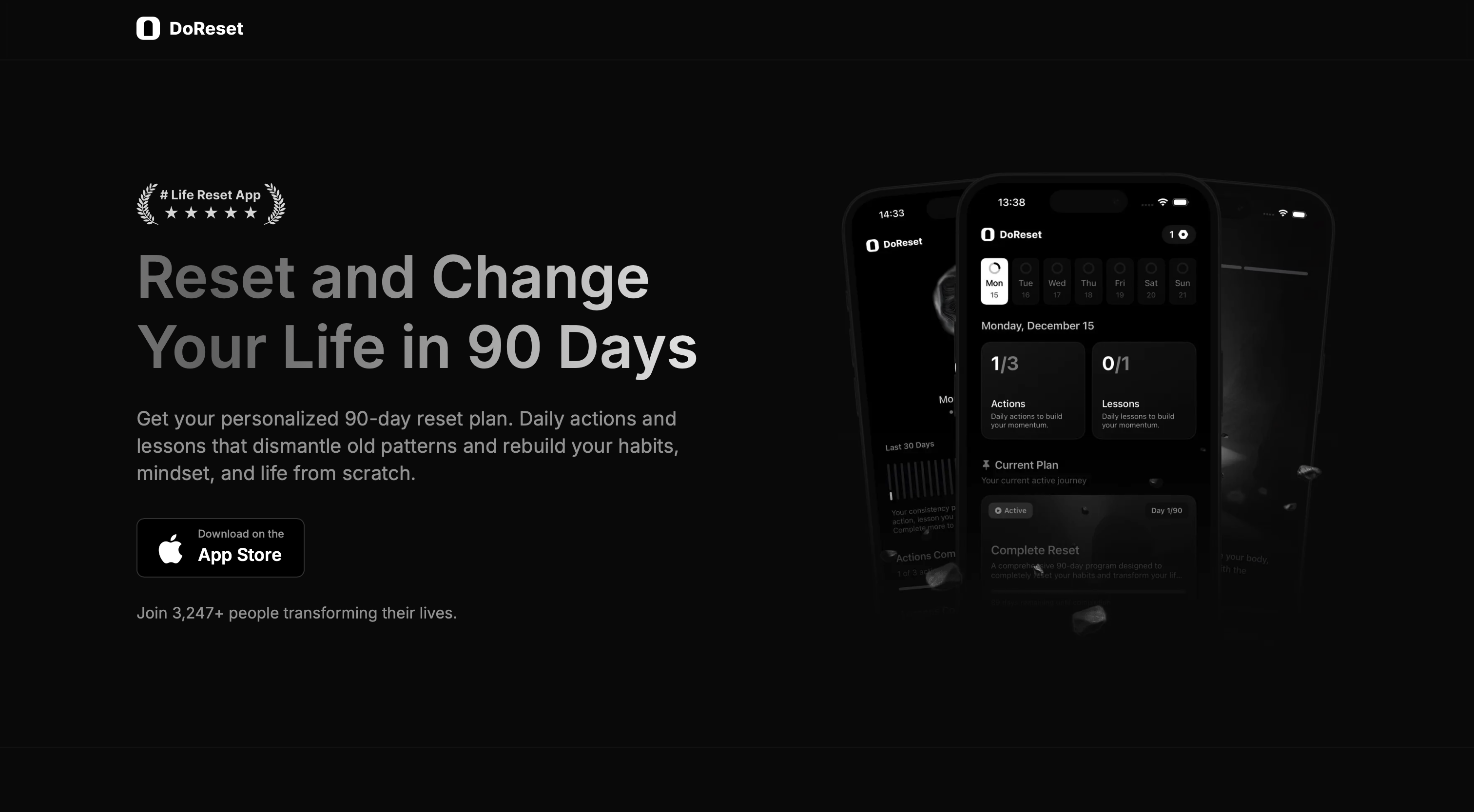
The DoReset mobile app provides this structure through a personalized 90-day reset plan that delivers specific actions and lessons each day, removing the guesswork from your transformation journey. Rather than wondering what to do next, you receive guided steps that build upon each other, creating momentum that carries you through resistance.
Comprehensive personal development requires attention to multiple life domains simultaneously. You can't transform your health while neglecting your relationships, or develop professionally while your emotional well-being deteriorates. Integration matters more than isolated improvement.
Dismantling Old Patterns Without Self-Judgment
Here's what nobody tells you about changing for life: before you can build something new, you need to consciously dismantle what isn't working. This isn't about criticizing yourself or dwelling on past mistakes. It's about clearly seeing the patterns you've developed, understanding why they exist, and deliberately choosing to release them.
The Archaeology of Your Habits
Every pattern you have served a purpose at some point. The avoidance protected you from pain. The people-pleasing earned you acceptance. The perfectionism kept you safe from criticism. These behaviors weren't character flaws. They were survival strategies developed by someone doing their best with limited resources.
Now they're limitations. The protection has become a prison. The acceptance comes at the cost of authenticity. The safety prevents growth. Recognizing this with compassion rather than judgment changes everything.
Pattern dismantling process:
- Identify the behavior you want to release
- Understand the original purpose it served
- Acknowledge how it's limiting you now
- Develop alternative strategies that serve your current needs
- Practice the new response consistently until it becomes automatic
This work requires tremendous courage. You're voluntarily giving up familiar coping mechanisms before the new ones feel reliable. You're choosing temporary discomfort for long-term freedom. Most people aren't willing to do this, which is why most people don't experience lasting transformation.
Building a New Mindset From the Ground Up
Your mindset isn't something you have. It's something you build through repeated thoughts, beliefs, and interpretations. Every time you face a challenge, you're either reinforcing old mental patterns or constructing new ones. The stories you tell yourself about who you are and what's possible shape your reality more than any external circumstance.
Developing a reset mindset means questioning assumptions you've carried for years, maybe decades. It means examining beliefs you've never thought to examine because they felt like facts rather than interpretations.
| Old Mindset Pattern | Reset Mindset Pattern |
|---|---|
| "I'm not the type of person who..." | "I'm becoming someone who..." |
| "I've always been this way" | "I'm actively evolving" |
| "Change is hard for me" | "Change is a skill I'm developing" |
| "I should be further along" | "I'm exactly where I need to be" |

Practicing Mental Flexibility
Rigidity feels safe but prevents growth. When you hold tightly to specific outcomes, methods, or identities, you create fragility. Life will inevitably challenge your assumptions and disrupt your plans. Mental flexibility allows you to adapt without breaking.
This doesn't mean abandoning your values or goals. It means holding them loosely enough to adjust your approach as circumstances change. Personal growth directly impacts health and well-being in measurable ways, but only when you maintain enough flexibility to navigate obstacles rather than being defeated by them.
The Role of Support and Structure
You can't do this alone. Not because you're weak, but because humans are fundamentally social creatures who develop in relationship with others. Isolation makes transformation exponentially harder. Structure makes it exponentially easier.
Think about why gym memberships spike in January but attendance plummets by March. People have motivation but lack structure. They have goals but no system. They have desire but no daily guidance on what specifically to do.
Why structure matters for changing for life:
- Removes decision fatigue from an already challenging process
- Provides clear next steps when motivation wanes
- Creates accountability through consistent checkpoints
- Offers frameworks for navigating common obstacles
- Builds momentum through progressive challenges
The difference between someone who transforms their life and someone who remains stuck often comes down to having a system that guides them through the messy middle. Not inspiration. Not willpower. Structure.
Measuring Progress Beyond the Scale
We're conditioned to measure change through visible metrics. Pounds lost. Money earned. Followers gained. These external markers can indicate progress, but they miss the deeper transformation happening beneath the surface.
Changing for life requires new measurement systems that capture the subtle but significant shifts in how you think, feel, and relate to yourself and others. These internal changes precede external results and prove more sustainable over time.
Internal Progress Indicators
Notice when you respond differently to familiar triggers. Pay attention when old anxieties no longer grip you with the same intensity. Celebrate moments when you choose the harder right over the easier wrong. These victories matter more than any number on a scale or bank account.
Lifelong lessons emerge not from achieving specific outcomes but from developing the capacity to navigate whatever life presents. Your ability to maintain composure during chaos, to find meaning in difficulty, to stay committed to growth when it would be easier to quit-these capabilities compound in value over decades.
Creating Environments That Support Your Evolution
Your willpower is finite. Your environment is constant. If you're trying to change while surrounded by triggers, temptations, and reminders of your old identity, you're fighting an uphill battle unnecessarily. Redesigning your environment isn't cheating. It's strategic.
Environmental design principles:
- Make desired behaviors easier by reducing friction
- Make undesired behaviors harder by adding barriers
- Surround yourself with visual reminders of who you're becoming
- Curate relationships that support growth rather than maintain stagnation
- Create physical spaces that reflect your evolving identity
Practical personal development activities work best when embedded in supportive environments. You can meditate daily, journal consistently, and practice gratitude, but if you return to chaotic spaces with negative influences, you'll constantly fight against your surroundings.
Navigating Setbacks With Self-Compassion
You will stumble. You will have days where old patterns resurface with surprising strength. You will question whether changing for life is actually possible for you. These moments don't indicate failure. They reveal opportunities for deeper understanding and renewed commitment.
The difference between people who eventually transform and those who give up lies in how they interpret setbacks. One group sees evidence of inadequacy. The other sees valuable data about what needs adjustment.
The Compassionate Response Framework
When you notice yourself sliding back into old behaviors, pause before judging. Ask curious questions instead of issuing harsh criticisms:
- What need was I trying to meet with this behavior?
- What triggered the return to this pattern?
- What would I tell a dear friend experiencing this same situation?
- What can I learn from this to strengthen my system going forward?
This approach doesn't excuse the behavior. It contextualizes it in ways that promote learning rather than shame. Shame keeps you stuck. Understanding moves you forward.
Integration: Weaving Change Into Your Identity
Eventually, the practices that once felt foreign become simply who you are. You stop thinking of yourself as someone trying to be healthier and start identifying as someone who prioritizes well-being. The meditation practice isn't something you do. It's part of how you operate in the world.
This identity integration marks the transition from changing for life to having changed your life. The transformation that required conscious effort becomes unconscious competence. You're not acting against your nature anymore. You've fundamentally altered your nature.
This doesn't mean you're finished growing. It means you've established a foundation from which continued development feels natural rather than forced. You've built systems that support evolution as a lifestyle rather than a project with an endpoint.
The Ripple Effect of Personal Transformation
When you change authentically, everyone around you feels it. Not because you're preaching or trying to convert others, but because transformation radiates naturally. Your increased capacity to regulate emotions creates calmer interactions. Your clarity of values attracts aligned relationships. Your commitment to growth inspires others to examine their own patterns.
Transforming your life through personal development creates ripples that extend far beyond your individual experience. Children learn what's possible by watching parents evolve. Partners receive permission to pursue their own growth. Colleagues witness that change is achievable at any age or stage.
You become living proof that changing for life isn't reserved for the lucky or privileged. It's available to anyone willing to commit to the daily work of dismantling what doesn't serve them and building what does.
Changing for life isn't about perfection or overnight transformation. It's about committing to sustainable growth through structured daily actions that gradually reshape your habits, mindset, and identity. The journey requires compassion, consistency, and support systems that guide you through inevitable challenges. DoReset provides exactly this through a personalized 90-day plan that delivers daily lessons and actions specifically designed to help you dismantle old patterns and rebuild your life from scratch. Your transformation begins with a single decision to invest in becoming who you're truly capable of being.