
Build Discipline: A Compassionate Guide to Lasting Change

Doreset
March 29, 2026
We've all been there-staring at our goals, feeling the weight of our unfulfilled promises, wondering why we can't just "be more disciplined." If you're reading this, you're probably exhausted from beating yourself up about it. Here's the truth that might surprise you: your struggle doesn't mean you're broken or weak. The challenge to build discipline is deeply human, and it's one that deserves compassion, not criticism. When we understand what discipline actually is and how it develops, we can finally stop fighting ourselves and start working with our natural rhythms instead.
Understanding What Discipline Really Means
Discipline isn't about willpower or forcing yourself through misery. It's not a personality trait you either have or don't have, like eye color or height.
Real discipline is a skill you develop-a series of practices that become easier over time. Think of it like learning to play an instrument. Nobody expects you to sit down at a piano and immediately perform Beethoven. You start with single notes, then scales, then simple melodies. Building discipline works the same way.
The word "discipline" itself comes from the Latin "discipulus," meaning student or learner. This etymology reminds us that discipline is fundamentally about learning, not punishment. When you reset your mindset around what discipline means, you shift from self-criticism to self-development.
The Science Behind Habit Formation
Your brain is designed to conserve energy by creating automatic behaviors. When you repeat an action consistently, your brain builds neural pathways that make that action easier over time. This is why the first few weeks of any new habit feel impossibly hard-you're literally rewiring your brain.
Research shows that it takes anywhere from 18 to 254 days to form a new habit, with an average of 66 days. That variance exists because different behaviors have different complexity levels, and different people have different starting points.

Starting Where You Are
You don't need to overhaul your entire life tomorrow. In fact, trying to do so almost guarantees failure and disappointment.
The most compassionate approach to build discipline starts with radical honesty about your current capacity. Ask yourself:
- What's one small change I could make that feels 80% doable?
- What time of day do I naturally have the most energy?
- What existing routine could I attach a new habit to?
- What support systems do I already have in place?
Your answers to these questions matter more than any generic advice. A morning routine that works for someone without children or chronic illness might be completely unrealistic for you-and that's okay. The goal is progress that fits your life, not someone else's Instagram highlight reel.
The Power of Micro-Commitments
Instead of committing to hour-long workouts, start with five minutes. Instead of writing a novel, commit to one paragraph. Instead of completely overhauling your diet, add one vegetable to your lunch.
These micro-commitments serve two critical purposes. First, they're so small that your brain doesn't trigger massive resistance. Second, they build what psychologists call "self-efficacy"-your belief in your ability to succeed. Every time you keep a small promise to yourself, you strengthen your trust in yourself.
| Overwhelming Goal | Micro-Commitment Version | Why It Works |
|---|---|---|
| Exercise daily for 60 minutes | Move your body for 5 minutes | Removes intimidation, builds consistency |
| Read 50 books this year | Read one page before bed | Creates sustainable routine |
| Completely change your diet | Add one healthy food per week | Avoids overwhelm and restriction mindset |
| Wake up at 5 AM | Wake up 10 minutes earlier | Gradual adjustment prevents shock |
Building Your Daily Structure
Discipline thrives in structure, but structure doesn't mean rigidity. Think of it as creating guardrails, not prison bars.
When you plan your day with intention, you reduce decision fatigue and create space for the behaviors that matter most to you. This doesn't mean scheduling every minute-it means identifying your non-negotiables and protecting time for them.
Morning routines get a lot of attention, and for good reason. How you start your day often sets the tone for everything that follows. But your evening routine matters just as much. The actions you take before bed determine how well you sleep, which affects your energy, mood, and decision-making the next day.
Creating Routines That Actually Stick
Start with what already works. You already have routines, even if you don't call them that. Build on existing patterns rather than fighting against them.
Link new habits to established ones. This technique, called "habit stacking," uses your existing neural pathways as anchors. After I pour my coffee, I'll write three things I'm grateful for. After I brush my teeth, I'll do ten pushups.
Design for your worst day, not your best. Your routine should be sustainable even when you're tired, stressed, or sick. If it only works when everything is perfect, it won't last.
Build in flexibility. Life happens. Kids get sick. Work emergencies arise. A sustainable routine has built-in options for scaled-down versions of your commitments.

Handling Setbacks With Grace
Here's what nobody tells you about trying to build discipline: you will mess up. You'll skip days. You'll fall back into old patterns. And this is completely normal.
The difference between people who eventually succeed and those who give up isn't that successful people never fail-it's that they don't let failure mean anything catastrophic about their identity.
Reframing Your Relationship With "Failure"
Missing one workout isn't failure. It's data. It tells you something about your schedule, your energy levels, or your current capacity. When you approach setbacks with curiosity instead of judgment, you learn what you need to adjust.
Self-compassion isn't self-indulgence-it's actually the foundation of sustainable change. Research by Dr. Kristin Neff shows that people who practice self-compassion are more likely to persist in their goals because they don't get derailed by shame spirals.
When you slip up, try this three-step process:
- Acknowledge what happened without drama. "I didn't follow through on my commitment today."
- Get curious about why. "Was I overly tired? Did I take on too much? Did something unexpected happen?"
- Make one small adjustment. "Tomorrow I'll set a reminder" or "I'll reduce my commitment to something more realistic."
The Role of Environment in Discipline
You're not weak because you can't resist scrolling your phone. You're human, and your phone is designed by teams of engineers whose entire job is to make it irresistible. When you're trying to rebuild life patterns, your environment either supports you or sabotages you.
Making discipline easier isn't cheating-it's strategy. Professional athletes design their environments meticulously. They don't rely on willpower to eat well; they ensure their kitchens are stocked with nutritious food. They don't debate whether to train; they have scheduled sessions with coaches waiting for them.
Environmental Design Strategies
- Reduce friction for good habits: Lay out your workout clothes the night before. Prep healthy snacks on Sunday. Keep a water bottle at your desk.
- Increase friction for unwanted habits: Delete social media apps from your phone (you can still access them via browser, but the extra step matters). Put your credit card in a drawer instead of your wallet. Turn off notifications.
- Use visual cues: A book on your pillow reminds you to read. A yoga mat in your living room suggests stretching. Your journal next to your coffee maker prompts morning reflection.
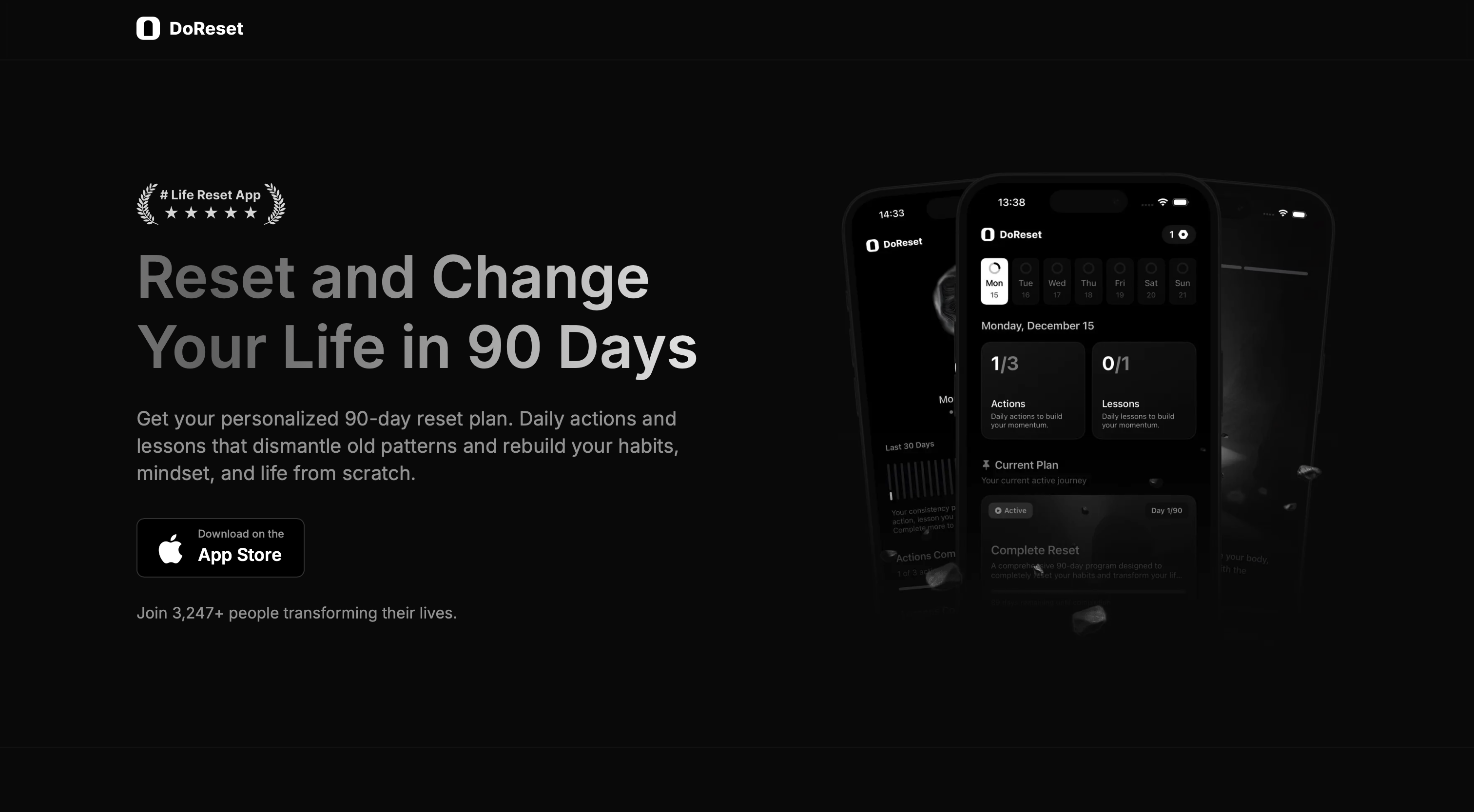
The DoReset mobile app provides this kind of environmental support by delivering daily actions directly to your phone-turning your device from a distraction into a tool for transformation through personalized guidance that meets you exactly where you are.
Building Support Systems
You don't have to build discipline alone, and trying to do so actually makes it harder. Humans are social creatures, and we're profoundly influenced by the people around us.
This doesn't mean you need to find a perfect accountability partner or join an expensive program. It means being intentional about the relationships and communities you engage with.
Ask yourself: Do the people I spend the most time with support the person I'm becoming? This isn't about abandoning friends who aren't "productive" enough. It's about recognizing that we naturally adopt the habits and attitudes of our social circles.
Forms of Support That Actually Help
Different people need different types of support. Some options include:
- Accountability partners who check in regularly about specific commitments
- Community groups (online or in-person) focused on similar goals
- Mentors or coaches who've already achieved what you're working toward
- Structured programs that provide daily guidance and track your progress
- Simple sharing with friends or family about what you're working on
The key is matching the support to your personality and needs. Introverts might prefer a private check-in system. Extroverts might thrive in group settings. Neither is better-what matters is what works for you.
Tracking Progress Without Obsession
Measurement can be incredibly motivating, showing you concrete evidence of improvement. But it can also become an obsession that undermines the very discipline you're trying to build.
The goal is awareness, not perfectionism. You're tracking to notice patterns and celebrate growth, not to judge yourself when numbers don't meet arbitrary standards.
| Tracking Method | Best For | Potential Pitfall |
|---|---|---|
| Habit tracker app | Visual learners, tech-comfortable people | Can become guilt-inducing checklist |
| Journal entries | Reflective thinkers, writers | May feel time-consuming |
| Photo progress | Physical changes, creative projects | Can trigger body image issues |
| Simple checkmarks | Minimalists, beginners | Might lack context or insights |
| Weekly reviews | Big-picture thinkers | May miss daily patterns |
Choose one simple method and stick with it for at least 30 days before evaluating whether it's working. The best tracking system is the one you'll actually use consistently.

The Long-Term Perspective
Building discipline isn't a sprint or even a marathon-it's a complete life reset that unfolds over time. In our culture of instant gratification, this can feel frustrating. We want transformation now.
But here's the beautiful truth: the slow, steady approach actually works better and lasts longer. When you build discipline gradually, you're not just changing behaviors-you're changing your identity. You become someone who follows through, who keeps promises to themselves, who builds the life they want one small action at a time.
Six months from now, you can be in exactly the same place, or you can be somewhere completely different. The difference isn't massive, dramatic action-it's consistent, small steps that compound over time.
Celebrating Milestones
Don't wait until you've "arrived" to acknowledge your progress. Celebrating small wins isn't frivolous-it's essential for maintaining motivation and reinforcing positive behavior.
Completed your morning routine for seven days straight? That deserves recognition. Chose the healthy option when you were stressed? Notice that victory. Returned to your practice after skipping a few days? That's actually the most important win of all.
Build celebration into your process. These don't need to be expensive or elaborate-sometimes recognition itself is enough. Sometimes you might treat yourself to something special. The key is acknowledging that you're making progress.
Making Discipline Feel Natural
Eventually, if you build discipline consistently and compassionately, something remarkable happens: the actions that once required tremendous effort become almost automatic. You don't debate whether to do them-you just do them, the same way you brush your teeth without conscious thought.
This is the ultimate goal-not to live in a state of constant forcing, but to create a life where the behaviors that serve you feel natural and aligned. When you reach this point, discipline doesn't feel like discipline anymore. It feels like living in integrity with your values.
This transformation doesn't happen overnight, and it doesn't happen through force. It happens through patience, consistency, self-compassion, and a willingness to keep showing up even when progress feels invisible. When you approach the journey to build discipline with understanding and kindness toward yourself, you create sustainable change that lasts.
The path to changing your mindset and habits isn't about becoming someone else-it's about becoming more fully yourself, freed from patterns that no longer serve you and empowered by practices that do.
Building discipline is a journey of self-discovery and growth that unfolds one small step at a time. When you approach it with compassion, realistic expectations, and consistent action, transformation becomes not just possible but inevitable. DoReset offers a personalized 90-day plan that guides you through this transformation with daily actions and lessons designed to dismantle old patterns and help you build the discipline that supports the life you want. Your reset begins with a single decision to start.